Gamewell FCI Releases New Fire Alarm Sounders to Meet Requirements for Commercial Sleeping Spaces

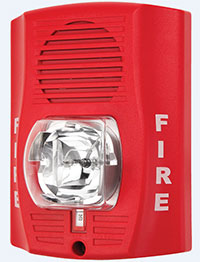
Gamewell-FCI by Honeywell announced the SpectrAlert Advance Series of low-frequency fire alarm sounders and sounder strobes to meet National Fire Alarm Association (NFPA) code requirements for sleeping areas in commercial buildings, such as hotels, school dormitories and assisted living facilities. The NFPA requirements went into effect January 1, 2014.
Gamewell FCI Releases New Fire Alarm Sounders to Meet Requirements for Commercial Sleeping SpacesThe MarkeTrak series of surveys concludes 35 million Americans, or 11.3% of the U.S. population, have some degree of hearing loss. This and other similar studies estimate the number to rise to more than 40 million by 2025.

A series of research studies, titled Optimizing Fire Alarm Notification for High Risk Groups funded by the Fire Protection Research Foundation, concluded that allow frequency tone, around 520 Hz, is more effective at waking sleeping individuals including those with mild-to-severe hearing loss. Due to these findings, a code change was initiated in the 2010 edition of NFPA 72: National Fire Alarm & Signaling Code, requiring new, commercial sleeping areas to utilize low-frequency sounders. Gamewell FCI Releases New Fire Alarm Sounders to Meet Requirements for Commercial Sleeping SpacesThis new requirement is located in Section 18.4.5: Sleeping Area Requirements and has been carried over to the current 2013 edition of NFPA 72.
“As awareness and enforcement of this new code grows, we expect customer demand for these low-frequency appliances to pick-up quickly,” said Brian Carlson, Gamewell-FCI marketing manager. “We [Gamewell-FCI] always aim to produce technology to increase occupant safety, and we support those who adopt code changes quickly.”

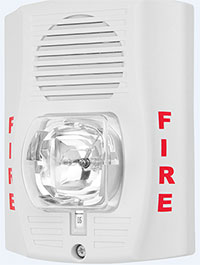
The new SpectrAlert Advance sounders and sounder strobes from Gamewell-FCI produce a low frequency alarm signal centered around 520 Hz. Both devices are UL-listed for wall and ceiling mount installations and the strobes produce a high-candela output.

Featured

  • Security Industry Association Announces the 2026 Security Megatrends

    The Security Industry Association (SIA) has identified and forecasted the 2026 Security Megatrends, which form the basis of SIA’s signature annual Security Megatrends report defining the top 10 factors influencing both near- and long-term change in the global security industry. Read Now

  • The Future of Access Control: Cloud-Based Solutions for Safer Workplaces

    Access controls have revolutionized the way we protect our people, assets and operations. Gone are the days of cumbersome keychains and the security liabilities they introduced, but it’s a mistake to think that their evolution has reached its peak. Read Now

  • A Look at AI

    Large language models (LLMs) have taken the world by storm. Within months of OpenAI launching its AI chatbot, ChatGPT, it amassed more than 100 million users, making it the fastest-growing consumer application in history. Read Now

  • First, Do No Harm: Responsibly Applying Artificial Intelligence

    It was 2022 when early LLMs (Large Language Models) brought the term “AI” into mainstream public consciousness and since then, we’ve seen security corporations and integrators attempt to develop their solutions and sales pitches around the biggest tech boom of the 21st century. However, not all “artificial intelligence” is equally suitable for security applications, and it’s essential for end users to remain vigilant in understanding how their solutions are utilizing AI. Read Now

  • Improve Incident Response With Intelligent Cloud Video Surveillance

    Video surveillance is a vital part of business security, helping institutions protect against everyday threats for increased employee, customer, and student safety. However, many outdated surveillance solutions lack the ability to offer immediate insights into critical incidents. This slows down investigations and limits how effectively teams can respond to situations, creating greater risks for the organization. Read Now

New Products

  • HD2055 Modular Barricade

    Delta Scientific’s electric HD2055 modular shallow foundation barricade is tested to ASTM M50/P1 with negative penetration from the vehicle upon impact. With a shallow foundation of only 24 inches, the HD2055 can be installed without worrying about buried power lines and other below grade obstructions. The modular make-up of the barrier also allows you to cover wider roadways by adding additional modules to the system. The HD2055 boasts an Emergency Fast Operation of 1.5 seconds giving the guard ample time to deploy under a high threat situation.

  • Luma x20

    Luma x20

    Snap One has announced its popular Luma x20 family of surveillance products now offers even greater security and privacy for home and business owners across the globe by giving them full control over integrators’ system access to view live and recorded video. According to Snap One Product Manager Derek Webb, the new “customer handoff” feature provides enhanced user control after initial installation, allowing the owners to have total privacy while also making it easy to reinstate integrator access when maintenance or assistance is required. This new feature is now available to all Luma x20 users globally. “The Luma x20 family of surveillance solutions provides excellent image and audio capture, and with the new customer handoff feature, it now offers absolute privacy for camera feeds and recordings,” Webb said. “With notifications and integrator access controlled through the powerful OvrC remote system management platform, it’s easy for integrators to give their clients full control of their footage and then to get temporary access from the client for any troubleshooting needs.”

  • Unified VMS

    AxxonSoft introduces version 2.0 of the Axxon One VMS. The new release features integrations with various physical security systems, making Axxon One a unified VMS. Other enhancements include new AI video analytics and intelligent search functions, hardened cybersecurity, usability and performance improvements, and expanded cloud capabilities