Aviation Police Officers Ask for Guns to Bolster Security

Aviation Police Officers Ask for Guns to Bolster Security

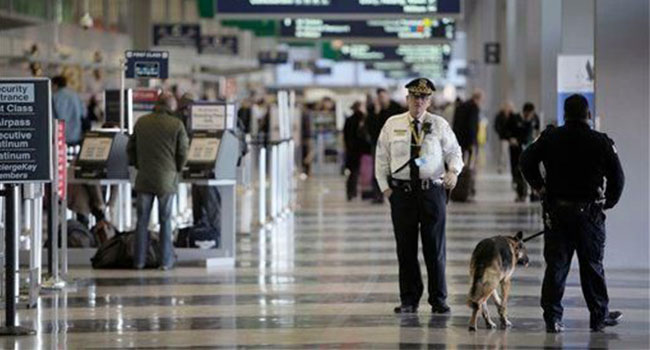
The union representing aviation police officers at Chicago’s two airports is asking Mayor Rahm Emanuel to bolster security by allowing officers to carry guns.

Investigations have found that hundreds of aviation police officers are not armed and are often taught to “run and hide” in the event of an active shooter.

A longstanding policy prohibits those aviation police officers from carrying a gun even though they are certified law enforcement officers. About 300 of them work along with armed Chicago police, which is the primary law enforcement agency at both airports.

Matt Brandon, secretary-treasurer or Local 73 of the Service Employees International Union, wrote a letter to Emmanuel stating, “The Safety of the flying public that utilize the Midway and/or O’Hare airports, and the APOs (aviation police officers) who are an integral part of the security of these airports is at high risk for compromise.”

Brandon argues that the “run and hide” technique that aviation police officers are taught goes against everything that is taught in the Chicago Police Academy, that the “ostrich approach to attacks on the flying public and employees/personnel at Midway and O’Hare airports cannot be part of any rational security strategy.

In a statement to CNN Wednesday, a spokesman for the aviation department cited numerous security awards for Chicago's airports and wrote, "The multi-layered security approach at O'Hare and Midway Airports is working to keep passengers, employees, and security officials safe. The close coordination between Aviation Security Officers, the Chicago Police Department, TSA, U.S. Customs and Border Control, and the FBI has a successful track record of keeping the airports secure."

About the Author

Sydny Shepard is the Executive Editor of Campus Security & Life Safety.

Featured

New Products

  • 4K Video Decoder

    3xLOGIC’s VH-DECODER-4K is perfect for use in organizations of all sizes in diverse vertical sectors such as retail, leisure and hospitality, education and commercial premises.

  • PE80 Series

    PE80 Series by SARGENT / ED4000/PED5000 Series by Corbin Russwin

    ASSA ABLOY, a global leader in access solutions, has announced the launch of two next generation exit devices from long-standing leaders in the premium exit device market: the PE80 Series by SARGENT and the PED4000/PED5000 Series by Corbin Russwin. These new exit devices boast industry-first features that are specifically designed to provide enhanced safety, security and convenience, setting new standards for exit solutions. The SARGENT PE80 and Corbin Russwin PED4000/PED5000 Series exit devices are engineered to meet the ever-evolving needs of modern buildings. Featuring the high strength, security and durability that ASSA ABLOY is known for, the new exit devices deliver several innovative, industry-first features in addition to elegant design finishes for every opening.

  • Luma x20

    Luma x20

    Snap One has announced its popular Luma x20 family of surveillance products now offers even greater security and privacy for home and business owners across the globe by giving them full control over integrators’ system access to view live and recorded video. According to Snap One Product Manager Derek Webb, the new “customer handoff” feature provides enhanced user control after initial installation, allowing the owners to have total privacy while also making it easy to reinstate integrator access when maintenance or assistance is required. This new feature is now available to all Luma x20 users globally. “The Luma x20 family of surveillance solutions provides excellent image and audio capture, and with the new customer handoff feature, it now offers absolute privacy for camera feeds and recordings,” Webb said. “With notifications and integrator access controlled through the powerful OvrC remote system management platform, it’s easy for integrators to give their clients full control of their footage and then to get temporary access from the client for any troubleshooting needs.”