White House Security Expanded After Breaches

White House Security Expanded After Breaches

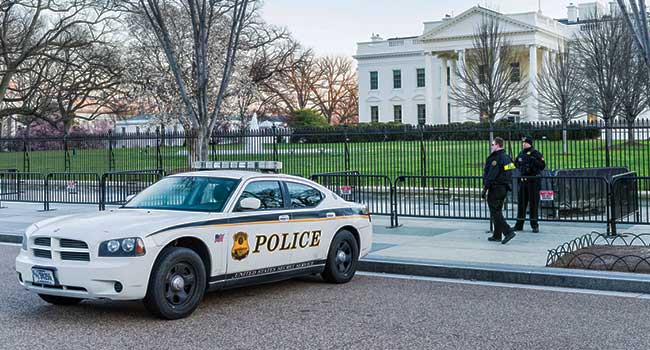
The Secret Service will be expanding the security perimeter around the south end of the White House after two intruder events last month.

The new restricted area will include the sidewalks, roadways and parkland areas between the south fence line of the White House and E Street, NW, from the Executive Avenue to East Executive Avenue. Pedestrians will be barred from the sidewalk bordering the South Lawn of the complex, the Secret Service said in a statement.

The new plan will attempt to replicate a buffer zone created on Pennsylvania Avenue, where iron bicycle racks were placed in front of the perimeter fence to provide officers with additional time to react to fence jumpers.

"Restricting public access to the fence line will not only serve to lessen the possibility of individuals illegally accessing the White House grounds," Secret Service Communications Director Cathy Milhoan said "but will also create a clear visual break to enable Secret Service officers to identify and respond to potential hazards including individuals attempting to scale the fence."

The changes come after two incidents in March, the first involving a man carrying a backpack who jumped an outer-perimeter fence on the complex’s southeast side and spent 17 minutes on White House grounds while President Trump was inside.

Less than a week later, a woman was arrested after she got her shoelaces tangled after trying to jump the White House fence.

Featured

New Products

  • A8V MIND

    A8V MIND

    Hexagon’s Geosystems presents a portable version of its Accur8vision detection system. A rugged all-in-one solution, the A8V MIND (Mobile Intrusion Detection) is designed to provide flexible protection of critical outdoor infrastructure and objects. Hexagon’s Accur8vision is a volumetric detection system that employs LiDAR technology to safeguard entire areas. Whenever it detects movement in a specified zone, it automatically differentiates a threat from a nonthreat, and immediately notifies security staff if necessary. Person detection is carried out within a radius of 80 meters from this device. Connected remotely via a portable computer device, it enables remote surveillance and does not depend on security staff patrolling the area.

  • Mobile Safe Shield

    Mobile Safe Shield

    SafeWood Designs, Inc., a manufacturer of patented bullet resistant products, is excited to announce the launch of the Mobile Safe Shield. The Mobile Safe Shield is a moveable bullet resistant shield that provides protection in the event of an assailant and supplies cover in the event of an active shooter. With a heavy-duty steel frame, quality castor wheels, and bullet resistant core, the Mobile Safe Shield is a perfect addition to any guard station, security desks, courthouses, police stations, schools, office spaces and more. The Mobile Safe Shield is incredibly customizable. Bullet resistant materials are available in UL 752 Levels 1 through 8 and include glass, white board, tack board, veneer, and plastic laminate. Flexibility in bullet resistant materials allows for the Mobile Safe Shield to blend more with current interior décor for a seamless design aesthetic. Optional custom paint colors are also available for the steel frame.

  • ResponderLink

    ResponderLink

    Shooter Detection Systems (SDS), an Alarm.com company and a global leader in gunshot detection solutions, has introduced ResponderLink, a groundbreaking new 911 notification service for gunshot events. ResponderLink completes the circle from detection to 911 notification to first responder awareness, giving law enforcement enhanced situational intelligence they urgently need to save lives. Integrating SDS’s proven gunshot detection system with Noonlight’s SendPolice platform, ResponderLink is the first solution to automatically deliver real-time gunshot detection data to 911 call centers and first responders. When shots are detected, the 911 dispatching center, also known as the Public Safety Answering Point or PSAP, is contacted based on the gunfire location, enabling faster initiation of life-saving emergency protocols.