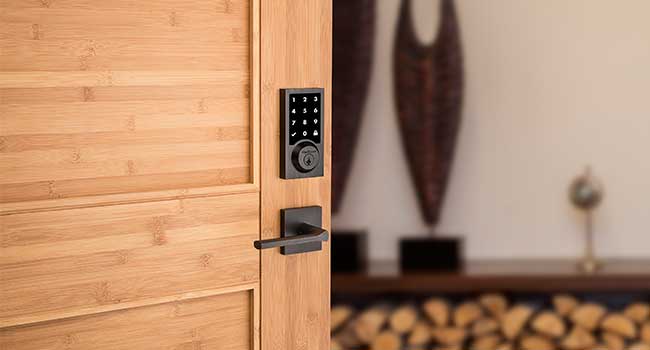
How to Increase Smart Locks Sales by Going Beyond the Front Door
The main entry to every home is an ideal starting point for smart locks sales.
- By Nick English
- Oct 02, 2017
The main entry to every home is an ideal starting point for smart locks sales. Smart locks have a natural place at the front door where they help provide maximum security while serving as the centerpiece of a smart home and acting as an extension of a home automation central hub. In fact, a home security and automation system that does not include a smart lock cannot be considered a complete security solution. According to a recent Consumer Electronics Association report, home security is a key component of home automation technologies: 36% of households with smart home systems have a security product installed.
When located at the front door, smart locks not only put access control at the homeowner’s fingertips, they provide home automation system control at what is often the home’s most convenient location. Most people interact with their front door lock on a daily basis – usually several times per day. For the ultimate in convenience, residents can program their front door lock to initiate specific scenarios every time they unlock the door, including disarming their home security system, turning on lights in the foyer, setting temperature levels, and opening blinds.
Go beyond the front door, over to the side and around back.
It makes sense that many smart lock sales begin at the main entrance to a home. But to best serve customer needs and get the most out of each sale, dealers, installers and integrators should consider the advantages of thinking outside the box, and beyond the front door.
Today, smart locks are available in a complete range of price points, in many different styles and with a full spectrum of capabilities. With the introduction of more affordable smart locks, your customers might consider putting smart locks at secondary entrance points. These locks use a wireless protocol to enable true remote locking and unlocking. This means that homeowners can remotely access and control the locks from anywhere in the world, using a smartphone, tablet or Internet connected device.
This remote access and control, combined with advanced security features, makes some of the more affordable smart locks an ideal option to add to secondary entrances such as side doors, back doors, or even basement doors. With a smart lock at the side door, parents who are away from home can grant access through the mud room to their kids returning home from school, or the dog walker who has arrived to walk Fido. Plus, with the lower pricing, there’s no reason why every entrance to the home can’t provide the superior security of advances like re-key technology, protection from lock bumping, the ability to keep misaligned doors locked, and other advanced features. Homeowners know all too well that criminals don’t always use the front door.
Profitable sales, inside and out.
Many smart locks feature traditional or touchscreen keypads. Owners of these locks can use a personal user code for entry into the home. With these locks, homeowners can also assign a time-sensitive user code to whomever might need one, and delete it when they see fit. In this way, homeowners are not passing out copies of keys to friends, relatives, neighbors and contractors – keys that can be lost or stolen. These smart locks are a remarkably safe way to allow access to a home – or separate parts of a home.
In fact, smart locks that work with personal user codes are a hugely beneficial complement and potentially profitable home automation upsell when paired with a wide array of home additions and special rooms, both inside and outside the home:
- Provide adults-only user codes for entrance to a wine cellar, bar area or liquor storage room.Give in-laws, tenants or guests user codes for access to their own in-law suite, apartment, or section of the house. Guest houses can also feature their own smart locks with distinct personal user codes.
- Do your customers have a storage shed where they house expensive gardening or landscaping equipment? Suggest that they protect that investment with a smart lock on the shed so they can give time-sensitive user codes to gardeners, landscapers, carpenters and other workers.
- If prospective customers have a swimming pool, they may also have a pool equipment storage shed that’s home to expensive furniture, toys, cleaning supplies and chemicals. Adding a smart lock can keep the kids out (and away from the chemicals), while allowing timed access to a weekly pool cleaning company or person.
- Many people have home offices, either inside the home or in a separate building on the property. Perhaps they’ve converted a basement into a workspace, or they’ve turned a barn into a painting or sculpture studio. They may want to use a smart lock for added security, plus the ability to remotely grant access to co-workers or clients.
Connecting with opportunities.
There are countless other applications for smart locks when you think beyond the front door. There are garage workshops, buildings used to store antique cars, gun or weapons storage rooms or closets, libraries that are home to valuable books, and many more. All of these different sections of a home can benefit from the security and selective access provided by smart locks.
Some of these applications may also warrant taking advantage of the connected nature of certain smart locks. Connected smart locks can act as extensions of a home automation hub. Each of these smart locks can be used to wirelessly communicate with and control the devices that make up some or all of a home automation system. For maximum convenience and control, a smart lock located outside a wine cellar can be connected to the thermostats in that space, or a smart lock located on a library door can be used to control the humidity within that room and protect valuable books. A smart lock near the pool can be used to control colored light scenarios around the pool and under the water, as well as the music playing out of the outdoor speakers in the backyard.
Security, convenience, style and versatility: these are the attributes that make smart locks play such an essential role in today’s home automation systems. Just remember that smart locks can make themselves right at home in many applications beyond the expected -- beyond the front door. Taking your customers on a tour of the possible locations for smart locks in their home can be an intriguing and potentially profitable activity.