North Carolina Library Defends Decision to Install Cameras in Bathrooms

North Carolina Library Defends Decision to Install Cameras in Bathroom

Rocky Mount Library says the cameras in the bathroom are a matter of security.

In this new technology-driven world, most people are aware of the fact they are on camera when they are in public spaces. For security and monitoring reasons, businesses, facilities and schools have installed security cameras as both a deterrent and evidence gathering device in the case of a crime.

For a Rocky Mount, North Carolina library, the areas in which they installed their security cameras was widened when they realized the amount of problems they were seeing in their restrooms. 

"Someone stood on a toilet and kicked another fixture off the wall," Braswell Memorial assistant director Phillip Whitford said. "We began to be worried that, what if someone was having this kind of rage fit and another patron walked in, particularly a child?"

Braswell explained that the library was seeing several incidents a week in their bathrooms and had no way of knowing that something was happening or evidence of who did it. 

The library, after consulting with an attorney and researching state law on the subject, decided to install cameras in the bathroom area.

"The cameras do not point at stalls," Whitford said. "They do not point at urinals. You can't see any reflections in the mirrors in those areas."

The cameras are stationary and cannot be moved or angled. They also cannot be zoomed in. The video recorded by these cameras is fed to a digital recorder that remains in a locked room at the library. Footage is only accessed in the event of an incident.

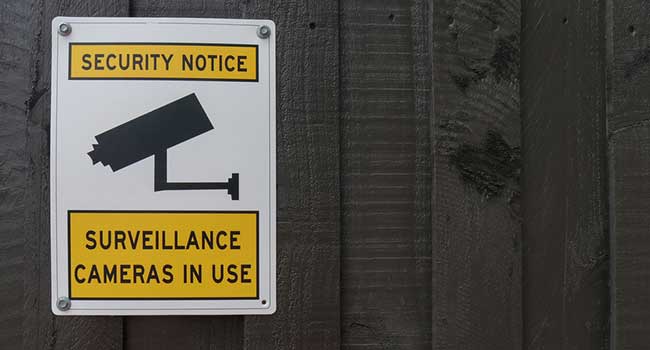
Signs indicting that there is a camera present in the bathroom were hung upon installation. The signs read: "The common areas of this restroom under surveillance for your protection."

Some locals believe that the cameras are an invasion of privacy, even if they only record common areas of the bathroom. Whitford told WRAL local news that they did extensive research on the subject before installing the cameras and under North Carolina state law, they are allowed to record the areas. He mentioned that other businesses in the city also record the common areas of their restroom to deter and record incidents.

Library officials say since the installation of the cameras, there have been no incidents in the bathrooms.

About the Author

Sydny Shepard is the Executive Editor of Campus Security & Life Safety.

Featured

  • Improve Incident Response With Intelligent Cloud Video Surveillance

    Video surveillance is a vital part of business security, helping institutions protect against everyday threats for increased employee, customer, and student safety. However, many outdated surveillance solutions lack the ability to offer immediate insights into critical incidents. This slows down investigations and limits how effectively teams can respond to situations, creating greater risks for the organization. Read Now

  • Security Today Announces 2025 CyberSecured Award Winners

    Security Today is pleased to announce the 2025 CyberSecured Awards winners. Sixteen companies are being recognized this year for their network products and other cybersecurity initiatives that secure our world today. Read Now

  • Empowering and Securing a Mobile Workforce

    What happens when technology lets you work anywhere – but exposes you to security threats everywhere? This is the reality of modern work. No longer tethered to desks, work happens everywhere – in the office, from home, on the road, and in countless locations in between. Read Now

  • TSA Introduces New $45 Fee Option for Travelers Without REAL ID Starting February 1

    The Transportation Security Administration (TSA) announced today that it will refer all passengers who do not present an acceptable form of ID and still want to fly an option to pay a $45 fee to use a modernized alternative identity verification system, TSA Confirm.ID, to establish identity at security checkpoints beginning on February 1, 2026. Read Now

  • The Evolution of IP Camera Intelligence

    As the 30th anniversary of the IP camera approaches in 2026, it is worth reflecting on how far we have come. The first network camera, launched in 1996, delivered one frame every 17 seconds—not impressive by today’s standards, but groundbreaking at the time. It did something that no analog system could: transmit video over a standard IP network. Read Now

New Products

  • 4K Video Decoder

    3xLOGIC’s VH-DECODER-4K is perfect for use in organizations of all sizes in diverse vertical sectors such as retail, leisure and hospitality, education and commercial premises.

  • ResponderLink

    ResponderLink

    Shooter Detection Systems (SDS), an Alarm.com company and a global leader in gunshot detection solutions, has introduced ResponderLink, a groundbreaking new 911 notification service for gunshot events. ResponderLink completes the circle from detection to 911 notification to first responder awareness, giving law enforcement enhanced situational intelligence they urgently need to save lives. Integrating SDS’s proven gunshot detection system with Noonlight’s SendPolice platform, ResponderLink is the first solution to automatically deliver real-time gunshot detection data to 911 call centers and first responders. When shots are detected, the 911 dispatching center, also known as the Public Safety Answering Point or PSAP, is contacted based on the gunfire location, enabling faster initiation of life-saving emergency protocols.

  • A8V MIND

    A8V MIND

    Hexagon’s Geosystems presents a portable version of its Accur8vision detection system. A rugged all-in-one solution, the A8V MIND (Mobile Intrusion Detection) is designed to provide flexible protection of critical outdoor infrastructure and objects. Hexagon’s Accur8vision is a volumetric detection system that employs LiDAR technology to safeguard entire areas. Whenever it detects movement in a specified zone, it automatically differentiates a threat from a nonthreat, and immediately notifies security staff if necessary. Person detection is carried out within a radius of 80 meters from this device. Connected remotely via a portable computer device, it enables remote surveillance and does not depend on security staff patrolling the area.