Bringing it Together
Better Security and Safety with Unified Critical Communications
- By Bruce Czerwinski
- Jul 28, 2025
Public safety communications have long been used to help first responders save lives and to help keep first responders safe, improve response time, and enhance interagency coordination. These communication solutions may include mobile (5G), radio telecommunication and mass notification systems.
Another type of critical communication is business critical communications, which are technologies that are essential for maintaining the daily operational efficiency of an organization as well as keeping their employees, visitors, and other assets safe. Communication and audio technologies such as voice evacuation systems, IP speakers, and intercoms play a significant role in a business-critical communication solution.
Additional technologies that are used with critical communication technologies for facility security include access control, alarms, surveillance cameras and perimeter detection systems.
Today’s intercoms, public address, IP speakers, help points, phone systems, background music systems, and more are critical for safety and security, but also for broader communications needs for operational and entertainment.
When they work together, the benefits are many. But if they are disparate, that can lead to many challenges, such as a high total cost of ownership, multiple vendors and inventory, overlapping technologies, and multiple systems to onboard staff. It can also mean slow response times due to siloed operations between security and life safety.
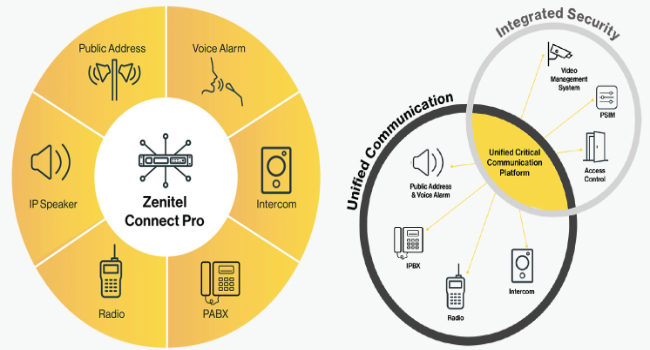
Fortunately, there is a way to connect all disparate audio systems– intercoms, voice alarms, public address, IP speakers, and more – with your VMS, access control, and PSIM.
It could mean:
Improved communications. When multiple communication technologies are unified, it reduces reliance on a single technology and avoids service interruption due to a single technology failure. Imagine a scenario where the radio system is out of service in an industrial plant. Using fixed intercom panels, security can still communicate and send emergency voice messages. In school settings, security teams can deliver broadcast messages to intercoms inside the classroom, even if the bell system fails.
Reduced response times. A unified critical communication platform increases situation awareness, ensuring everyone has the latest information on a critical situation. Security operators can also reach a wider audience. Unification also simplifies communication processes, allowing for quicker decision-making, smoother coordination, and more efficient resource allocation.
Easy onboarding of operators. Since all information is united under a single user interface, operators no longer need to learn multiple systems. It can also empower operators by giving them the information they need to be more efficient, make better decisions and respond faster to incidents.
Better integration points. When critical communication solutions are unified as a single system, system integrators can reduce the overall number of integration points, which leads to manageable system architectures while reducing complexity and risk. Fewer integration points mean fewer integration points to manage and support, which can improve system reliability and reduce downtime.
Unification also offers other benefits for control room operators and system integrators. Most security and communications platforms today will require control room operators to use multiple systems because none offer the required functionalities in one user interface. By bringing all critical communication technologies under a single platform, unification provides everything a control room operator needs within a unified software suite and Graphical User Interface (GUI). This helps to monitor security breaches and run investigations from a single GUI.
Overall, unification of critical communication transition translates to:
- Reduced total cost of ownership
- Better situational awareness
- A faster upgrade path
- Increased cybersecurity
- Better system availability
- Easier onboarding and training
Use Cases
There are three areas within a facility where critical communication solutions play a vital role: audio for safety, audio for security, and audio for daily operations. They all provide one-to-one, one-to-many, and one-to-all communications.
A Unified Critical Communication solution can help distinct types of facilities in those three areas.
Hospitals and medical professionals must manage patient care in highly stressful situations. That is why it is crucial for hospital and healthcare staff to have a unified solution that enables clear and prompt communication. With unified critical communication solutions, collaboration between medical teams becomes more fluid.
In an operating room, an intercom facilitates immediate assistance for nurses and surgeons during surgery and allows them to communicate messages without leaving the sterile area. If there is a safety concern in the operating room, surgeons can initiate a code blue emergency using the intercom system, broadcasting a message throughout the hospital’s loudspeakers to inform staff and request assistance.
Prisons are high-risk environments where an altercation can quickly escalate into a deadly incident. Prison guards must take coordinated actions swiftly to maintain a high level of security for themselves, visitors, and inmates.
With a unified critical communication platform, prison security teams can manage calls and communications from cells; issue emergency alerts throughout the prison in the event of a riot, lockdown or medical emergency; enable communication among staff when a security response is needed, such as an unauthorized entry by a prisoner and more.
Train stations are busy facilities, and the challenge lies in ensuring that coordination across multiple trains, operators and facilities runs seamlessly to provide the best possible travel experience for passengers. Rail staff and security staff at a train station need to be vigilant and act quickly, and they need to collaborate with rail staff as well as external teams such as police and ambulance services. Here, communication technologies can interact with passengers who have a medical emergency, page staff for backup and communicate with emergency services teams.
Bringing it Together
The unification of critical communication technologies represents a paradigm shift in communication. It is a transition from traditional, siloed communication to a collaborative communication approach. A unified critical communication platform brings together a multitude of communication technologies and tools into a single platform and eliminates the reliance on a single technology.
It combines the strengths of many technologies and ultimately allows all users seamlessly move from one communication technology to another.
It is no longer necessary to work with multiple disparate systems that can hinder business efficiency and growth and possibly impact the safety and security of your facilities. A unified critical communications platform is the pathway to your secure, safe, resilient and efficient enterprise.
This article originally appeared in the July / August 2025 issue of Security Today.