Working In Harmony
Medical center creates sensible access migration plan
- By Jennifer Toscano
- Jun 12, 2009
Citrus Valley Medical Center is proving that the access control system world is not all or nothing; its more than choosing between strictly mechanical or only networked solutions. From implementing simple stand-alone systems to networked access control, the hospital has been showing how various types of access control technologies can coexist. From one database, the hospital staff can manage online and offline locking systems, as well as set a foundation to integrate other critical security management functions such as CCTV.
Citrus Valley Health Partners serves a Southern California community of approximately 930,000 people. Located just east of Los Angeles, includes more than 3,000 staff members, more than 1,000 physicians and four outstanding healthcare facilities. The Queen of the Valley Campus is renowned for its maternity and child health services. The Inter-Community Campus offers the only open-heart surgery program in the area and specializes in cancer treatment and support. Foothill Presbyterian Hospital offers general acute care and specialty services, and Citrus Valley Hospice is one of the first freestanding hospices of its kind in California.
Seeking the Best Solution
“Providing security is a challenge, and we have been implementing a new, growing system over the past four years,” said Frank Michaud, manager of security services at Citrus Valley Medical Center in Covina, Calif. “Initially, certain offices needed special locks to keep people out and only allow authorized people in. Over the years, too many master keys had been distributed. But, before jumping into just any solution, the security staff decided to sit back and analyze what was really needed.”
Health facilities security staff employed a Best locks system and could not simply change to another system, as the cost of re-keying the four facilities would be prohibitive. Thus, a turnkey solution was needed at the door itself. At the same time, the security department knew they needed the flexibility to add new access control solutions over the coming years, and did not want to continually replace recently installed items just to take advantage of other access control solutions.
Security staff attended a Best seminar discussing electronic access control and heard about the Schlage Security Management System. There they learned that while a user might require a mechanical lock today, they might need a basic stand-alone electronic locking solution in the future. They also may want to add credentials such as proximity or smart cards, and later migrate to a networked system deploying both stand-alone and networked access control and even video integration. As a result, users should create an easy migration path from one technology to the next.
To learn more, staff members met with the local Ingersoll Rand Integration Services group and found that the Schlage system is comprised of four software levels specifically designed to seamlessly migrate from one level to the next as security requirements expand, while being able to leave existing databases and hardware intact.
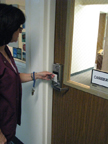
That was the direction the healthcare security staff wanted. In order to meet initial needs, the first step was to execute an overall migration plan to CM locking systems. CM locks are ideal for older doors and facilities that need to be retrofitted with higher-security locks. CM locking systems offer many of the same benefits as a networked, hardwired system, without the higher cost and additional care associated with routing network cable when retrofitting an existing facility with electronic access control. These stand-alone, programmable, battery-powered locks are networked through software to provide audit-trail capability and time-based scheduling for restricting access.
The Security Management System software programs all types of credentials, including the locks, access trim and offline hard-wired controllers, which manage strikes and magnets, from a laptop or PDA. New users, access points and access privileges can be entered into the system in seconds. The software also provides an audit trail capability. With about 20 of these locks on doors throughout the Inter-Community Campus, security decided to access them via proximity cards instead of a PIN number via a keypad for convenience and to set up a system-wide ID credential program.
From One Access Control Opportunity to Another
The hospital had just built a new emergency department on the Foothill Presbyterian campus, and officials thought it was important for it to be controlled remotely from the security department on the Inter-Community Campus. Using a hardwired locking system in the hospital itself, doctors and staff can open various doors within the facility at any time, but the public is restricted to using the main lobby only.
The hardwired locks let security use CM-type locks to monitor door openings with the same Security Management Systems software. For these locks, security staff doesn’t have to visit each lock in order to program them or download audit trail information. This open architecture platform seamlessly connects the specially designed door lock to a panel interface board that connects to an access control panel, which takes direction from the computer at the Inter-Community Campus. There is no need for separate components or multiple manufacturers' products. Users can access these Schlage VIP locks with either magnetic stripe or proximity cards.
As a result, credential data and door status information required by the access control panel, such as door position or request-to-exit status, are passed via RS-485 communication from the lock to the panel through the PIB provided with the locks. The access control panel maintains control of the lock status and status indication on the VIP locks. All monitoring is captured at the remote monitoring station.
“In order to control both campuses from one location and, if needed, lock the facilities down quickly, we created a wireless communications system,” Michaud said. “This wireless system also would be beneficial later as we began to better secure doors in our older facilities, which had no gateways or tubing for lines a typical problem in so many hospitals.
“Assuring other departments that our wireless communication system would not interfere with their wireless systems, including mobile phones, we started implementing the system. Using five transmitters, security went wireless on all exterior doors to secure and control the perimeter and control flow.”
In the next phase of the security migration, wired locks were used inside and were brought online via the wireless communications system. Officials also networked all exterior doors, instead of keeping them as stand-alone units. The migration path of the CM locks made this easy.
“We also are beginning to shut down more doors,” Michaud said. “We ask each department manager where they want a CM lock. They told us they didn’t want people wandering through medical rooms, computer rooms, the cardiology laboratory and the hazardous-waste areas. Once the locks were installed, only authorized staff were granted access to these areas by swiping their ID cards.”
Learning the System
The Security Management System has a moderate learning curve, since it is a very powerful security solution. It is compatible with the Microsoft Windows 2000, 2003 and XP Pro operating environments, offering advanced access control, alarm monitoring, digital video, photo ID badging and visitor management. Transactions, associated video and badging photos can be viewed simultaneously, eliminating the need to access multiple systems or flip to alternate screens. Its diverse software includes integrated digital video management, which may be incorporated later.
Adding electronic locking systems to access points as time and budgets allow is a sensible migration plan for any healthcare organization. A large campus may have dozens of doors with varying levels of security needs. A broom closet may be adequately secured with a simple offline lock, while surveillance or computer rooms may demand high-security biometric solutions integrated with access control systems. The right lock system for a given door may be found anywhere along the electronic migration path. It’s important to plan for these situations at the beginning so the migration is simple and budget-friendly.
About the Author
Jennifer Toscano is the marketing manager at Ingersoll Rand Security Technologies, Schlage Electronic Security, electronic locks.