Emergency Calls Integrate With IP Video Surveillance In Malaysian City

Cyberjaya has become the first Malaysian city to deploy a system that allows local police to remotely monitor the location of an incident, immediately after receiving an emergency call.

This is achieved by interfacing IndigoVision’s IP video solution with the Malaysian Emergency Response Service (MERS) 999 system, which is part of the overall integrated CCTV surveillance system commissioned by IndigoVision’s local approved Partner, GTC Global Sdn Bhd.

Speaking at the launch of the integrated system at Cyberjaya Police Station, Inspector General of Police Tan Sri Musa Hassan said, “The MERS 999 provides a uniform platform for handling emergency calls from the Police, Fire and Rescue Services, Health Ministry and Civil Defense Department. This allows better coordination between the agencies especially after police are able to use CCTV to check on the type and seriousness of the emergency and assess the assistance that is needed.”

The ability for the police to assess a situation immediately and provide a fast response deters criminals and allows the authorities to provide the correct assistance for victims following an incident. Being able to check on the scene of an emergency also means that the police can identify crank calls. This improves efficiency and ensures resources are directed to dealing with actual emergencies.

Using a fiber network designed by GTC Global Sdn Bhd, a total of 30 IndigoVision series 9000 IP PTZ vandal-proof domes were installed at various high traffic and populated areas around the town. Loudspeakers were also fitted alongside many of the cameras allowing control room operators to broadcast warning or help messages using an integrated intercom system.

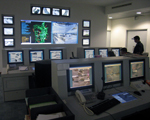
In the central control room operators use ‘Control Center’, IndigoVision’s Security Management Software to view live camera feeds and analyze recorded video. Evidential quality video clips can be exported as evidence for use in court.

Then an emergency call is received, its location is displayed on the main GIS Map. The operator then displays the nearest camera and remotely controls its PTZ movement to view the incident. IndigoVision’s compression technology means that high-quality H.264 video can be streamed around the network with minimum bandwidth requirement. This ensures minimum latency, allowing operators to smoothly control the PTZ domes from long distances. This was one of the main reasons IndigoVision was chosen for this project.

Video is recorded on an IndigoVision Windows NVR, with Raid 5 storage, providing a 30 day archive. The amount of storage required compared to comparable systems is significantly lower due to the efficiency of the compression technology and to advanced features such as Activity Controlled Framerate (ACF), which is used in the IP domes.

ACF is a unique feature that reduces the framerate at which video is transmitted from the camera during periods of scene inactivity. As soon as the camera detects motion, the video is automatically streamed at maximum framerate. This can considerably reduce the amount of recorded video, particularly during the night or at quieter locations.

Featured

  • Empowering and Securing a Mobile Workforce

    What happens when technology lets you work anywhere – but exposes you to security threats everywhere? This is the reality of modern work. No longer tethered to desks, work happens everywhere – in the office, from home, on the road, and in countless locations in between. Read Now

  • TSA Introduces New $45 Fee Option for Travelers Without REAL ID Starting February 1

    The Transportation Security Administration (TSA) announced today that it will refer all passengers who do not present an acceptable form of ID and still want to fly an option to pay a $45 fee to use a modernized alternative identity verification system, TSA Confirm.ID, to establish identity at security checkpoints beginning on February 1, 2026. Read Now

  • The Evolution of IP Camera Intelligence

    As the 30th anniversary of the IP camera approaches in 2026, it is worth reflecting on how far we have come. The first network camera, launched in 1996, delivered one frame every 17 seconds—not impressive by today’s standards, but groundbreaking at the time. It did something that no analog system could: transmit video over a standard IP network. Read Now

  • From Surveillance to Intelligence

    Years ago, it would have been significantly more expensive to run an analytic like that — requiring a custom-built solution with burdensome infrastructure demands — but modern edge devices have made it accessible to everyone. It also saves time, which is a critical factor if a missing child is involved. Video compression technology has played a critical role as well. Over the years, significant advancements have been made in video coding standards — including H.263, MPEG formats, and H.264—alongside compression optimization technologies developed by IP video manufacturers to improve efficiency without sacrificing quality. The open-source AV1 codec developed by the Alliance for Open Media—a consortium including Google, Netflix, Microsoft, Amazon and others — is already the preferred decoder for cloud-based applications, and is quickly becoming the standard for video compression of all types. Read Now

  • Cost: Reactive vs. Proactive Security

    Security breaches often happen despite the availability of tools to prevent them. To combat this problem, the industry is shifting from reactive correction to proactive protection. This article will examine why so many security leaders have realized they must “lead before the breach” – not after. Read Now

New Products

  • Camden CV-7600 High Security Card Readers

    Camden CV-7600 High Security Card Readers

    Camden Door Controls has relaunched its CV-7600 card readers in response to growing market demand for a more secure alternative to standard proximity credentials that can be easily cloned. CV-7600 readers support MIFARE DESFire EV1 & EV2 encryption technology credentials, making them virtually clone-proof and highly secure.

  • AC Nio

    AC Nio

    Aiphone, a leading international manufacturer of intercom, access control, and emergency communication products, has introduced the AC Nio, its access control management software, an important addition to its new line of access control solutions.

  • Connect ONE’s powerful cloud-hosted management platform provides the means to tailor lockdowns and emergency mass notifications throughout a facility – while simultaneously alerting occupants to hazards or next steps, like evacuation.

    Connect ONE®

    Connect ONE’s powerful cloud-hosted management platform provides the means to tailor lockdowns and emergency mass notifications throughout a facility – while simultaneously alerting occupants to hazards or next steps, like evacuation.