
Circuit of the Americas Hosts Formula One with Community
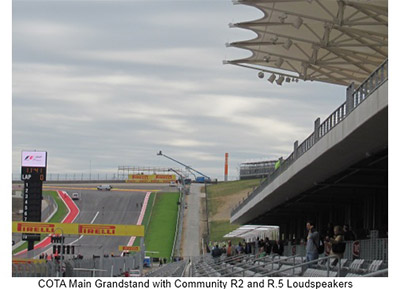 Austin’s Circuit of the Americas (COTA) is America’s first purpose-built Formula One racing track. Completed in late 2012, COTA’s campus includes the Main Grandstand with VIP Lounge, the Grand Plaza with food court and shops, a 251-foot (77m) Observation Tower and the Pit Building with an adjacent Media Center. The track also includes bleachers at several locations to supplement the Grandstand seating.
Although the Formula One and other races are the site’s main attractions, A/V systems play major supporting roles. Architect Tilke’s Formula One designs include race control systems, and basic audio and video systems, but Circuit of the Americas chose to upgrade and/or supplement the A/V systems in many areas.
Circuit of the Americas retained consultant Acoustic Dimensions for many of the venue’s networks, and for the audio and video system upgrades. Acoustic Dimensions value engineered the low-voltage systems and, in cooperation with Hughes Associates, led the effort to comply with the mass notification code. AT&T, the overall campus technology contractor, chose Ford AV to assist in the A/V systems field design and installation.
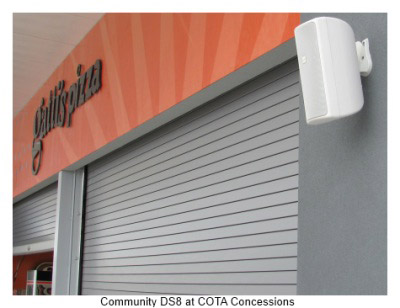 The original audio specification consisted primarily of paging horns for race audio and public announcements. To meet COTA’s request for A/V upgrades, Acoustic Dimensions and Ford AV set up a loudspeaker performance evaluation for Circuit of the Americas’ management personnel. Conventional paging horns were used as a baseline, and two upgraded systems were offered for comparison. Circuit of the Americas selected Community’s R-Series for their overall performance and sound quality, their reputation for long-term, outdoor durability and their high sensitivity (efficiency) which reduced amplifier requirements and helped Circuit of the Americas meet its budget guidelines.
Community R2s, R.5HPs and WET Series loudspeakers are used in the Main Grandstand, on the track and in other outdoor areas. Community’s Distributed Design Series ceiling and surface-mount loudspeakers are used in the Main Grandstand, the Grandstand VIP Lounge and the Pit Building. Community VERIS2 loudspeakers are used in the Media Center with the video systems. Audio electronics include Crown amplifiers, BSS London DSPs and Soundcraft digital mixing consoles.
Acoustic Dimension’s Craig Janssen said, “Circuit of the Americas is very pleased with the choice of Community loudspeakers for these systems.”