Ultra ID Releases New Proximity Access Cards

Ultra ID Releases New Proximity Access Cards
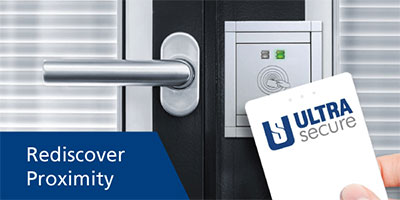
Ultra ID Releases New Proximity Access CardsProximity cards are one of the most ubiquitous technologies for physical security. They are used throughout office buildings, hospitals, schools and other organizations to unlock doors, open gates and monitor access to secure facilities.

UltraSecure proximity cards were designed from the ground-up by Ultra ID to simplify the process of installing additional or replacement proximity cards at any secure facility. They seamlessly integrate with all existing proximity systems. An advanced read/write data chip allows the UltraSecure card to hold one of 137 billion unique security codes. The chip is compatible with 26-40 bit proximity systems including all standard and most custom formats.

Many legacy proximity cards have a bulky “clamshell” design in order to increase durability. UltraSecure cards have a thin, credit-card ISO CR-80 form factor that matches the durability of “clamshell” cards by incorporating high-strength PET composite plastics into the card design. PET composite is stronger than the PVC plastic that is used in many traditional proximity cards, so UltraSecure credentials resist warping and yellowing. Unlike PVC, PET is also recyclable so that facilities using UltraSecure cards can meet Zero Waste goals.

UltraSecure proximity credentials are produced in the United States and internationally by a network of ISO 9001 certified manufacturing facilities and proprietary personalization centers. Ultra ID has leveraged its experience in card personalization to shorten the supply chain for proximity cards so that users can receive custom-programmed shipments of up to 10,000 proximity credentials in under a week from an Ultra ID dealer. Moreover, Ultra ID guarantees every credential for as long as it is in use and supports customers with locally staffed technical support teams.

Featured

  • The Evolution of IP Camera Intelligence

    As the 30th anniversary of the IP camera approaches in 2026, it is worth reflecting on how far we have come. The first network camera, launched in 1996, delivered one frame every 17 seconds—not impressive by today’s standards, but groundbreaking at the time. It did something that no analog system could: transmit video over a standard IP network. Read Now

  • From Surveillance to Intelligence

    Years ago, it would have been significantly more expensive to run an analytic like that — requiring a custom-built solution with burdensome infrastructure demands — but modern edge devices have made it accessible to everyone. It also saves time, which is a critical factor if a missing child is involved. Video compression technology has played a critical role as well. Over the years, significant advancements have been made in video coding standards — including H.263, MPEG formats, and H.264—alongside compression optimization technologies developed by IP video manufacturers to improve efficiency without sacrificing quality. The open-source AV1 codec developed by the Alliance for Open Media—a consortium including Google, Netflix, Microsoft, Amazon and others — is already the preferred decoder for cloud-based applications, and is quickly becoming the standard for video compression of all types. Read Now

  • Cost: Reactive vs. Proactive Security

    Security breaches often happen despite the availability of tools to prevent them. To combat this problem, the industry is shifting from reactive correction to proactive protection. This article will examine why so many security leaders have realized they must “lead before the breach” – not after. Read Now

  • Achieving Clear Audio

    In today’s ever-changing world of security and risk management, effective communication via an intercom and door entry communication system is a critical communication tool to keep a facility’s staff, visitors and vendors safe. Read Now

  • Beyond Apps: Access Control for Today’s Residents

    The modern resident lives in an app-saturated world. From banking to grocery delivery, fitness tracking to ridesharing, nearly every service demands another download. But when it comes to accessing the place you live, most people do not want to clutter their phone with yet another app, especially if its only purpose is to open a door. Read Now

New Products

  • ResponderLink

    ResponderLink

    Shooter Detection Systems (SDS), an Alarm.com company and a global leader in gunshot detection solutions, has introduced ResponderLink, a groundbreaking new 911 notification service for gunshot events. ResponderLink completes the circle from detection to 911 notification to first responder awareness, giving law enforcement enhanced situational intelligence they urgently need to save lives. Integrating SDS’s proven gunshot detection system with Noonlight’s SendPolice platform, ResponderLink is the first solution to automatically deliver real-time gunshot detection data to 911 call centers and first responders. When shots are detected, the 911 dispatching center, also known as the Public Safety Answering Point or PSAP, is contacted based on the gunfire location, enabling faster initiation of life-saving emergency protocols.

  • EasyGate SPT and SPD

    EasyGate SPT SPD

    Security solutions do not have to be ordinary, let alone unattractive. Having renewed their best-selling speed gates, Cominfo has once again demonstrated their Art of Security philosophy in practice — and confirmed their position as an industry-leading manufacturers of premium speed gates and turnstiles.

  • FEP GameChanger

    FEP GameChanger

    Paige Datacom Solutions Introduces Important and Innovative Cabling Products GameChanger Cable, a proven and patented solution that significantly exceeds the reach of traditional category cable will now have a FEP/FEP construction.