New Security Lanes Help to Diminish Long Lines

New Airport Security Lanes Help to Diminish Long Lines

Soon, travelers looking to go through airport security in Los Angeles, Dallas, Miami and Chicago will be able to slip through the process a little faster.

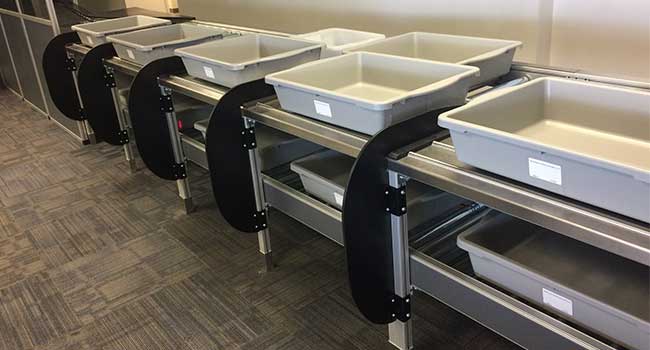
Los Angeles International Airport, Dallas-Fort Work International Airport, Miami National Airport and O’Hare will soon implement new “innovation lanes” at security checkpoints. The two new lanes, first introduced at Hartsfield-Jackson Atlanta International Airport, are designed to use multiple conveyor belts to allow up to five passengers to simultaneously unload bags, shoes and clothes into bins to be screened by the TSA.

Airline officials from United Airlines say the lanes speed up the TSA screening lines because the conveyor belts eliminate bottlenecks caused by travelers who are slow to unload their belongings. Other passengers using the lane at the same time can easily slide their bins around the slower traveler.

In addition to the conveyor belt that moves bins into the screening area, there will be a separate belt continuously bringing by new bins, so that there will never be a shortage.

TSA officials say United is working to install more of these lanes at Newark Liberty International Airport in New Jersey and Chicago O’Hare International Airport.

The change comes as TSA moves to beef up security following the attack on the Brussels airport in March 2016. Three men detonated bombs at the screening area of the airport injuring more than 300 people. The new security lanes could help to diminish the amount of time travelers spend in line waiting to be screened, giving perpetrators less of a chance to attack a soft target.

Featured

  • The Evolution of IP Camera Intelligence

    As the 30th anniversary of the IP camera approaches in 2026, it is worth reflecting on how far we have come. The first network camera, launched in 1996, delivered one frame every 17 seconds—not impressive by today’s standards, but groundbreaking at the time. It did something that no analog system could: transmit video over a standard IP network. Read Now

  • From Surveillance to Intelligence

    Years ago, it would have been significantly more expensive to run an analytic like that — requiring a custom-built solution with burdensome infrastructure demands — but modern edge devices have made it accessible to everyone. It also saves time, which is a critical factor if a missing child is involved. Video compression technology has played a critical role as well. Over the years, significant advancements have been made in video coding standards — including H.263, MPEG formats, and H.264—alongside compression optimization technologies developed by IP video manufacturers to improve efficiency without sacrificing quality. The open-source AV1 codec developed by the Alliance for Open Media—a consortium including Google, Netflix, Microsoft, Amazon and others — is already the preferred decoder for cloud-based applications, and is quickly becoming the standard for video compression of all types. Read Now

  • Cost: Reactive vs. Proactive Security

    Security breaches often happen despite the availability of tools to prevent them. To combat this problem, the industry is shifting from reactive correction to proactive protection. This article will examine why so many security leaders have realized they must “lead before the breach” – not after. Read Now

  • Achieving Clear Audio

    In today’s ever-changing world of security and risk management, effective communication via an intercom and door entry communication system is a critical communication tool to keep a facility’s staff, visitors and vendors safe. Read Now

  • Beyond Apps: Access Control for Today’s Residents

    The modern resident lives in an app-saturated world. From banking to grocery delivery, fitness tracking to ridesharing, nearly every service demands another download. But when it comes to accessing the place you live, most people do not want to clutter their phone with yet another app, especially if its only purpose is to open a door. Read Now

New Products

  • FEP GameChanger

    FEP GameChanger

    Paige Datacom Solutions Introduces Important and Innovative Cabling Products GameChanger Cable, a proven and patented solution that significantly exceeds the reach of traditional category cable will now have a FEP/FEP construction.

  • Camden CM-221 Series Switches

    Camden CM-221 Series Switches

    Camden Door Controls is pleased to announce that, in response to soaring customer demand, it has expanded its range of ValueWave™ no-touch switches to include a narrow (slimline) version with manual override. This override button is designed to provide additional assurance that the request to exit switch will open a door, even if the no-touch sensor fails to operate. This new slimline switch also features a heavy gauge stainless steel faceplate, a red/green illuminated light ring, and is IP65 rated, making it ideal for indoor or outdoor use as part of an automatic door or access control system. ValueWave™ no-touch switches are designed for easy installation and trouble-free service in high traffic applications. In addition to this narrow version, the CM-221 & CM-222 Series switches are available in a range of other models with single and double gang heavy-gauge stainless steel faceplates and include illuminated light rings.

  • Luma x20

    Luma x20

    Snap One has announced its popular Luma x20 family of surveillance products now offers even greater security and privacy for home and business owners across the globe by giving them full control over integrators’ system access to view live and recorded video. According to Snap One Product Manager Derek Webb, the new “customer handoff” feature provides enhanced user control after initial installation, allowing the owners to have total privacy while also making it easy to reinstate integrator access when maintenance or assistance is required. This new feature is now available to all Luma x20 users globally. “The Luma x20 family of surveillance solutions provides excellent image and audio capture, and with the new customer handoff feature, it now offers absolute privacy for camera feeds and recordings,” Webb said. “With notifications and integrator access controlled through the powerful OvrC remote system management platform, it’s easy for integrators to give their clients full control of their footage and then to get temporary access from the client for any troubleshooting needs.”