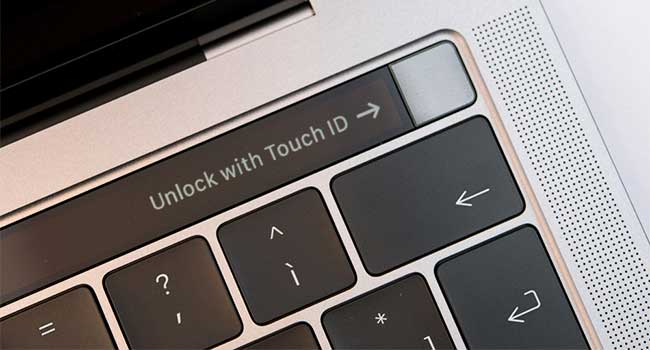
Apple Introduces New Touch ID and Security Chip to MacBook

Apple Introduces New Touch ID and Security Chip to MacBook Air

Apple's new security chip now disables MacBook's microphone when the lid closes.

Apple is increasing the security of their devices with new features like biometric Touch ID and a new security chip embedded in the new MacBook Air introduced on Tuesday. 

The new MacBook Air was revealed at the Apple Event in New York, and now includes Apple's Touch ID sensor on the keyboard. The fingerprint sensor is used to unlock devices and was introduced in the iPhone 5s in September of 2015. The biometric security feature has proven to be a faster, more convenient alternative to passwords. 

The Touch ID feature does more than unlock the new MacBook Air, however. You can not use the biometric feature to shop using Apple Pay as well as authenticate third-party apps.

Your fingerprint data is encrypted and secured on Apple's T2 security chip, which uses Secure Enclave. All your data, including passwords and your fingerprint is stored on the device and doesn't leave the MacBook Air. The tech giant explained they don't even receive the data.

Apple's T2 chip will now also disable your MacBook's microphone when the lid is closed, according to its latest security overview. This change is hardware-based, which means no software (including malware from potential hackers) can turn on your microphone when the lid is shut.  

The T2 chip was first introduced this summer, and adds an extra layer of security for all of Apple's devices. Though security features are often embedded in the processors, more tech giants have been replying on standalone chips.

About the Author

Sydny Shepard is the Executive Editor of Campus Security & Life Safety.

Featured

  • TSA Introduces New $45 Fee Option for Travelers Without REAL ID Starting February 1

    The Transportation Security Administration (TSA) announced today that it will refer all passengers who do not present an acceptable form of ID and still want to fly an option to pay a $45 fee to use a modernized alternative identity verification system, TSA Confirm.ID, to establish identity at security checkpoints beginning on February 1, 2026. Read Now

  • The Evolution of IP Camera Intelligence

    As the 30th anniversary of the IP camera approaches in 2026, it is worth reflecting on how far we have come. The first network camera, launched in 1996, delivered one frame every 17 seconds—not impressive by today’s standards, but groundbreaking at the time. It did something that no analog system could: transmit video over a standard IP network. Read Now

  • From Surveillance to Intelligence

    Years ago, it would have been significantly more expensive to run an analytic like that — requiring a custom-built solution with burdensome infrastructure demands — but modern edge devices have made it accessible to everyone. It also saves time, which is a critical factor if a missing child is involved. Video compression technology has played a critical role as well. Over the years, significant advancements have been made in video coding standards — including H.263, MPEG formats, and H.264—alongside compression optimization technologies developed by IP video manufacturers to improve efficiency without sacrificing quality. The open-source AV1 codec developed by the Alliance for Open Media—a consortium including Google, Netflix, Microsoft, Amazon and others — is already the preferred decoder for cloud-based applications, and is quickly becoming the standard for video compression of all types. Read Now

  • Cost: Reactive vs. Proactive Security

    Security breaches often happen despite the availability of tools to prevent them. To combat this problem, the industry is shifting from reactive correction to proactive protection. This article will examine why so many security leaders have realized they must “lead before the breach” – not after. Read Now

  • Achieving Clear Audio

    In today’s ever-changing world of security and risk management, effective communication via an intercom and door entry communication system is a critical communication tool to keep a facility’s staff, visitors and vendors safe. Read Now

New Products

  • AC Nio

    AC Nio

    Aiphone, a leading international manufacturer of intercom, access control, and emergency communication products, has introduced the AC Nio, its access control management software, an important addition to its new line of access control solutions.

  • Connect ONE’s powerful cloud-hosted management platform provides the means to tailor lockdowns and emergency mass notifications throughout a facility – while simultaneously alerting occupants to hazards or next steps, like evacuation.

    Connect ONE®

    Connect ONE’s powerful cloud-hosted management platform provides the means to tailor lockdowns and emergency mass notifications throughout a facility – while simultaneously alerting occupants to hazards or next steps, like evacuation.

  • Mobile Safe Shield

    Mobile Safe Shield

    SafeWood Designs, Inc., a manufacturer of patented bullet resistant products, is excited to announce the launch of the Mobile Safe Shield. The Mobile Safe Shield is a moveable bullet resistant shield that provides protection in the event of an assailant and supplies cover in the event of an active shooter. With a heavy-duty steel frame, quality castor wheels, and bullet resistant core, the Mobile Safe Shield is a perfect addition to any guard station, security desks, courthouses, police stations, schools, office spaces and more. The Mobile Safe Shield is incredibly customizable. Bullet resistant materials are available in UL 752 Levels 1 through 8 and include glass, white board, tack board, veneer, and plastic laminate. Flexibility in bullet resistant materials allows for the Mobile Safe Shield to blend more with current interior décor for a seamless design aesthetic. Optional custom paint colors are also available for the steel frame.