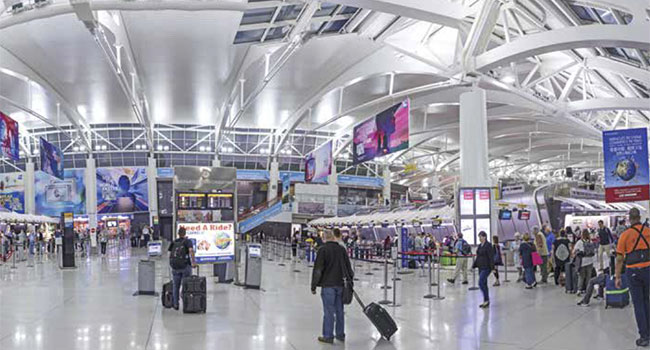
Adding Sound and Safety
Customs checkpoint areas at JFK airport gets a little help from friends
- By Richard Brent
- Feb 01, 2019
John F. Kennedy International Airport is the sixth busiest airport
in the United States, handling more than 59 million passengers
last year alone, according to the 2017 Traffic Report by the Port
Authority of New York and New Jersey. Located in New York City,
only 15 miles from Manhattan, JFK airport serves as a gateway to the
U.S. for travelers coming from destinations across the globe.
A key part of facilitating safe travel is ensuring that dangerous
people and substances do not enter the country. In July, immigration
officials arrested a woman—a U.S. citizen arriving at JFK airport from
Mexico—who had concealed more than nine pounds heroin valued
at $300,000.1
At JFK Airport, immigration officers process hundreds of international
passengers per flight. With the continual influx of people
combined with limited staffing, law enforcement personnel are increasingly
looking for technologies to enhance their efforts to deter
illegal entry or trafficking and aid in crime investigation.
The Need for Audio Clarity
In 2018, immigration checkpoint areas at the JFK airport needed to
upgrade their current security system with new, high-performing
technologies. Immigration and law enforcement officers were interested
in an audio monitoring solution that could produce clear
audio. Previously, JFK Airport international terminal one had been
outfitted with standard video surveillance and microphones. Much
like any airport, the high noise levels caused complications for the
audio equipment, which picked up ambient noise making playback
challenging.
To troubleshoot the issue, immigration officers turned to systems
integrator American Integrated Security Group (AISG). Based in
College Point, N.Y., AISG is one of the security industry’s leading
systems integrators, specializing in the design and deployment of
open platform integrated systems for several industries including
government, transportation and utilities. The integrator later called
in audio security company, Louroe Electronics, to assess the terminal’s
audio system.
The team did a full onsite evaluation of the current audio setup
and were able to identify the limitations of the current system,
which were due to the type of microphone deployed and where they were placed. The audio manufacturer also
showed immigration officials new audio
solutions that could enhance the entire security
system.
Security Upgrade and Installation
In order to improve situational awareness in
terminal one, a new audio system was designed
to include the deployment of over 100
microphones, which AISG installed in the
fall of 2018. The new system enables audio
capture capability throughout each step of
the immigration and customs process—from
initial checkpoint areas all the way to interview
and secondary screening rooms.
Louroe’s Verifact L-DT microphones are
placed at all 32 passport-check podiums to
verify interactions travelers have with officers.
Designed as a bi-directional microphone
that adheres to tabletop or counter
surfaces, the L-DT picks up sound from both
the officer and passenger while minimizing
background noise. For individuals detained
by agents for additional questioning and
asked to stand in the waiting area behind the
podium, the omnidirectional Verifact B-6
microphone is deployed. In this setup, the
B-6 is mounted on the high ceiling while the
microphone element is hung down and able
to capture audio from several feet below.
Bag checks are another important step
in the immigrations process. To ensure that
all sound is captured during screenings and
searches, Verifact LD-T microphones are
mounted on the podiums in the baggage
area, as well as the B-6 in the surrounding
area to capture any additional sound. The
sound from both microphones is combined
via the company’s RN-2 audio mixer, which
allows security staff to get a larger area for
that station.
For suspects who require further screening
or questioning, officers required audio
equipment in interview rooms, booking
areas, and holding cells. For these applications,
the Verifact A is simply mounted on
walls and ceilings in each interview room
and holding cell, and strategically placed on
the booking area ceiling. The microphones
can be integrated with all video surveillance
cameras and video management systems.
Technology Benefit
Having exceptional audio is imperative for
operations, so that immigration officers can
not only see but also hear exactly what is being
said. The audio also helps them to better
assess individuals. When reviewing footage
either in real-time or for forensic evaluation,
immigration officers look for any visual,
physiological and verbal cues that might indicate
falsehood or suspicious behavior. In
this regard, the audio has helped customs officers
gather additional information.
The sound component of the security
system also gives officials peace of mind,
knowing they have complete audio coverage
of the entire immigration and customs area
and that a verbal record of all needed conversations
will be clear and fully admissible
in court.
Cost-Savings
Not only did the new solutions produce exceptional
sound quality for the application,
but they also yielded a cost-savings. With the
ability to place the microphones directly into
the surveillance cameras, the integrator didn’t
have to install an additional interface to send
the audio to the video management system.
Additionally, when working with traditional
legacy or analog equipment, every microphone
and camera requires its own power
supply. Running cable through an airport
from the switchboard location to the installation
area is expensive and quite a challenge
due the constant flow of people. To solve
this issue, the organization deployed the IFPX
solution, which powers audio and video
equipment by a single Cat-5 cable.
By eliminating the need for extra equipment
and cabling, immigration officials were
able to save on infrastructure costs and AISG
was able to save on installation labor.
Looking Towards the Future
Crime prevention is a top priority for immigration
officers at the JFK Airport international
terminal. Thanks to its security
upgrade, officers are better equipped to deal
with the everyday challenges they face. In
fact, they plan to deploy the audio solutions
in other areas of the airport, including international
terminal seven. Immigration officials
are committed to adding sound and
safety to their operations at JFK airport and
protecting the public and our borders from
harmful materials and people.
This article originally appeared in the January/February 2019 issue of Security Today.