
Cloud software overlay with person clicking graphic

Effective Governance is Key to Enterprise Cloud Security

Large organizations are prioritizing hybrid models and operational oversight to ensure long-term resilience and regulatory compliance.

A growing gap exists between standard cloud adoption models and the complex governance requirements of large-scale enterprises. While the move to the cloud is often marketed as a simple transition, global organizations with hundreds of sites face unique regulatory and cybersecurity challenges that necessitate a more nuanced approach.

Recent data indicate that enterprise physical security rarely functions within a single deployment model. Instead, these organizations frequently maintain cloud, on-premises and hybrid environments simultaneously. Experts suggest that maintaining visibility and control across these diverse systems is essential for long-term operational stability.
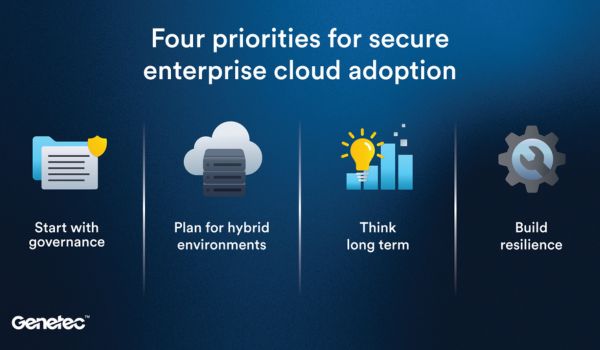
According to a 2026 industry survey of more than 7,300 respondents, hybrid-cloud adoption is increasingly viewed as a strategic necessity rather than a temporary phase. The study found that 39% of enterprises adopt hybrid environments for scalability, while 38% do so to ensure redundancy and business continuity.

Industry leaders argue that for the enterprise sector, the cloud should be viewed as an operating model rather than a final destination. This perspective emphasizes integrating cloud capabilities into existing infrastructure to strengthen oversight without compromising the ability to function during network disruptions or service outages.

To maintain security, organizations are encouraged to design systems that allow for autonomous operation. This ensures that physical security infrastructure remains functional even during outages or changing economic conditions. By focusing on accountability and graceful degradation across edge and cloud systems, enterprises can meet strict compliance standards while managing evolving risks.

About the Author

Jesse Jacobs is assistant editor of SecurityToday.com.

Featured

New Products

  • AC Nio

    AC Nio

    Aiphone, a leading international manufacturer of intercom, access control, and emergency communication products, has introduced the AC Nio, its access control management software, an important addition to its new line of access control solutions.

  • Luma x20

    Luma x20

    Snap One has announced its popular Luma x20 family of surveillance products now offers even greater security and privacy for home and business owners across the globe by giving them full control over integrators’ system access to view live and recorded video. According to Snap One Product Manager Derek Webb, the new “customer handoff” feature provides enhanced user control after initial installation, allowing the owners to have total privacy while also making it easy to reinstate integrator access when maintenance or assistance is required. This new feature is now available to all Luma x20 users globally. “The Luma x20 family of surveillance solutions provides excellent image and audio capture, and with the new customer handoff feature, it now offers absolute privacy for camera feeds and recordings,” Webb said. “With notifications and integrator access controlled through the powerful OvrC remote system management platform, it’s easy for integrators to give their clients full control of their footage and then to get temporary access from the client for any troubleshooting needs.”

  • ResponderLink

    ResponderLink

    Shooter Detection Systems (SDS), an Alarm.com company and a global leader in gunshot detection solutions, has introduced ResponderLink, a groundbreaking new 911 notification service for gunshot events. ResponderLink completes the circle from detection to 911 notification to first responder awareness, giving law enforcement enhanced situational intelligence they urgently need to save lives. Integrating SDS’s proven gunshot detection system with Noonlight’s SendPolice platform, ResponderLink is the first solution to automatically deliver real-time gunshot detection data to 911 call centers and first responders. When shots are detected, the 911 dispatching center, also known as the Public Safety Answering Point or PSAP, is contacted based on the gunfire location, enabling faster initiation of life-saving emergency protocols.