The Rise of the Unmanned Business: How Access Control Shapes the Future of Operations
Modern access control has evolved from a security lock into an automated business operations engine, enabling around-the-clock unstaffed fitness centers, coworking spaces, and retail hubs.
- By Maren Smith
- Jun 22, 2026
Imagine arriving at a gym at 1 a.m., unlocking the front door with your smartphone, completing a workout, and leaving without ever interacting with an employee. Now picture walking into a coworking space, making a fresh cup of coffee, and hosting a meeting in a reserved conference room, all without consulting any front desk staff. These scenarios aren’t futuristic concepts anymore—they’re becoming standard business practices across a rapidly growing range of industries.
At the heart of this shift towards unstaffed operations is a critical security technology: access control. Often viewed simply as a means of controlling entry into a restricted space, today’s access control systems are capable of functioning as enhanced operational platforms that allow modern businesses to run with little to no staff on-site. So as technology develops and the demand for convenient, seamless operations grows, access control will continue to emerge as a critical technology for the future of businesses.
Why Unmanned Operations Are Growing Today
An unmanned business is an operation that leverages technology to manage interactions, deliver services, and uphold day-to-day functionality with minimal or no staff physically present on-site. Common examples include gyms and fitness centers, self-storage facilities, vacation rentals, hospitality properties, package pickups and locker systems, coworking spaces, and more. In these environments, customers are able to gain access, complete transactions, and receive services independently. Staff members may still provide support remotely or visit occasionally for maintenance, but daily operations require little to no direct human involvement.
Several factors drive the shift towards unmanned business models today, beginning with convenience and around-the-clock availability. Traditional operating hours can significantly lessen customer convenience and business revenue, so shifting towards a model that offers continuous services comes as a direct benefit to any given business. For a traditional manned business, this requires employees to work at all hours of the day—putting notable organizational and financial strains on management. But for unmanned operations, functioning on a 24/7 basis requires no additional hiring, costly overnight shifts, or complex scheduling.
Rather, unmanned operations are able to provide services in an on-demand, convenient manner while subsequently saving operational costs on manpower.
While employees may continue to play an essential role in customer service, maintenance, and strategic functions, technology can automate many routine tasks that previously required on-site personnel. Automated enrollment, digital payments, remote monitoring, and self-service access can reduce the need for front-desk staff and administrative resources across a range of businesses.
Unmanned business models can also accelerate expansion and business growth. Opening a new location traditionally requires hiring and training staff before operations can begin. But with modern access control and management platforms, organizations can deploy standardized technology across multiple sites and oversee them remotely. This centralized approach enables operators to scale more quickly while maintaining consistency across locations.
From Security Tool to Business Platform
Although unmanned operations rely on several technologies, access control serves as the foundation that makes the entire model possible. At its most basic level, access control determines who can enter a facility, where they can go, and when they can gain access. In an unmanned environment, however, these systems take on a much broader role—modern access control platforms effectively become the digital gatekeepers of the business. They verify identities, enforce policies, automate permissions, and connect with other operational systems to create a seamless customer experience.
For example, a customer purchasing a gym membership online can automatically receive credentials, gain immediate access to member-only areas, and have permissions updated or revoked based on their billing status—all without staff involvement. Similarly, a coworking facility can grant temporary access to meeting rooms, manage visitor permissions, and automate entry schedules based on reservations. These capabilities transform access control from a standalone security solution into a core business operations platform.
The Value of Mobile Credentials
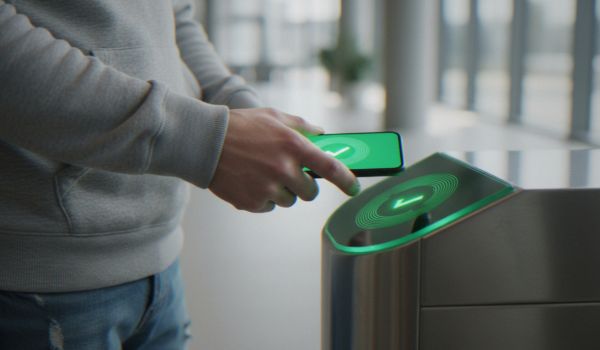
One of the most significant developments enabling unmanned businesses today is the widespread adoption of mobile access credentials. Rather than relying on physical keycards or fobs, mobile credentials allow users to access facilities through smartphones and/or digital wallets. This approach offers several advantages for both operators and customers. For users, mobile credentials provide convenience. Most people already carry a smartphone, eliminating the need to manage additional access devices like a traditional key, card, wristband, or fob.
And for businesses, mobile credentials reduce administrative burdens associated with issuing, replacing, and tracking physical credentials.
Mobile credentials also create opportunities for a richer customer experience. Imagine a person signs up online for a membership at an exclusive indoor golf studio. What sounds like a better user experience: coordinating a time to meet a staff member in person to receive a key card that grants them access to the space, or automatically receiving a convenient mobile credential the second they finish signing up? Not only does this provide immediate convenience to the customer, but the ability to instantly issue, modify, or revoke credentials from anywhere gives operators greater flexibility while ensuring that users can access their desired services whenever they need them.
How Software Integration Powers Operations
Access control is a critical foundation for unmanned businesses, but that security technology alone may not be enough to ensure complete operational efficiency. The most effective unmanned businesses today are created when access control systems integrate with other operational software platforms, like membership management systems, billing portals, reservation platforms, intercom solutions, and more.
When these systems work together, organizations can automate entire workflows that would otherwise require manual oversight. A new customer can register online, complete payment, receive a mobile credential, reserve a space, and gain immediate access—all through a connected digital ecosystem. Likewise, changes to memberships, payment status, or reservations can automatically trigger updates to access permissions, reducing administrative workloads and minimizing opportunities for human error.
Integrated systems can also boost the overall security of a space. By bringing access control together with tools like video surveillance or burglar alarms, businesses can create a more comprehensive security ecosystem. This level of integration strengthens both security and operational awareness without requiring constant on-site supervision.
The Future is Unmanned
The rise of unmanned businesses represents more than a technological trend—it reflects a large-scale shift in how modern organizations deliver services and how customers want, and expect, to engage with them. As these business types continue to expand across industries, access control will continue to play an integral role. No longer limited to simply securing doors, modern access control platforms have emerged as essential operational tools that connect people, spaces, and software into one seamless experience.