The Watchmen of Gotham
NYPD to extend Lower Manhattan Security Initiative to Midtown
Modeled after London’s “Ring of Steel,” New York City’s Lower Manhattan Security Initiative covers Battery Park to Canal Street -- and when completed, will include more than 3,000 security cameras, 100 license plate reading devices and chemical, biological, radiological and nuclear detectors.
All data streams into the Security Coordination Center and is monitored by the NYPD Counterterrorism Bureau. The network is designed to detect, observe and deter pre-operational terrorist activity in the financial district.
The city now plans to expand the surveillance system to Midtown -- from 30th to 60th Street -- using $24 million in homeland security grants.
“We are expanding our state-of-the-art counter-terrorism coordination center to include Midtown Manhattan,” Mayor Michael Bloomberg said in a press release. “Protecting potential targets is part of the comprehensive strategy we’ve pursued over the past seven and a half years to defend our city. We devote 1,000 police officers to counter-terrorism duties every day, and with a combination of high-tech intelligence and old-fashioned policing, we are doing everything in our power to keep our city safe from terrorist threats.”
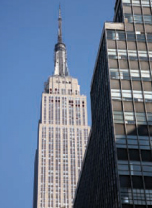
The coverage of the Midtown Manhattan Security Initiative includes sensitive and high-risk targets such as Penn Station, Grand Central Station, the Chrysler and Empire State Buildings, and the United Nations.
The new initiative is expected to be completed by 2011.
Right to Privacy
To ensure proper privacy protections, the initiatives must abide by the Public Security Privacy Guidelines. Under these guidelines, no person may be targeted or monitored solely because of race, color, religion or creed, age, national origin, alienage, citizenship status, gender (including gender identity), sexual orientation, disability, marital status, partnership status, military status, or political affiliation or beliefs.
The surveillance system will only be used to monitor public areas, where no legally protected reasonable expectation of privacy exists, and all CCTV equipment operated New Yorkers say the initiatives make them feel safe.
“I have nothing to hide, so I think it’s fine as long as it’s used for the right purposes,” said Ken Hill, 32, a programmer who works on Ninth Avenue and 15th Street. “This isn’t watching you in your home, it’s watching you on the street, out in public. I think it could be a valuable terrorism and crime-fighting tool. If I ended up being the victim of a street crime, I would certainly be thankful if it were caught on camera.”
“I don’t care about any privacy issues,” said Jarrod McFarlane, 33, a manager from Long Island. “It makes me feel safe.” Not surprisingly, other New Yorkers have an even more nonchalant approach.
“I suppose the overt, visual presence of the 3,000 cameras will eventually get to me,” said another Midtown resident. “But as a New Yorker, I’ll probably be jaded by all this in no time.”
And though some might be wary, in the end, they favor having the system.
“It’s a step toward Big Brother that we have always speculated about and feared,” said John Aro, 38, a consultant who works on Avenue of the Americas and 45th Avenue. “However, knowing it exists rather than guessing and making conspiracy theories about its existence is better. And as I don’t have anything to hide, I have no objections. In the end, I’m all for the safety of the whole than for the safety of the individual.”
Desperately Seeking Details
The New York Civil Liberties Union is demanding that NYPD disclose basic information about the Midtown Security Initiative.
“The NYPD is collecting massive amounts of personal information about law-abiding New Yorkers, with no hint of how it plans to protect individuals’ privacy,” said Donna Lieberman, NYCLU executive director, in a press release. “This is an invitation to abuse. The NYPD must not spend vast amounts of public money blanketing downtown and Midtown Manhattan in surveillance cameras without any public discussion of its plans or clear privacy protections. Our elected lawmakers need to step in and subject this entire surveillance system to a thorough public review.”
The NYCLU is interested in learning:
- The scope of information to be collected about law-abiding people;
- How the police and federal government would use the information and who they’ll share it with;
- How long the information would be stored;
- Any privacy protections within the system;
- What private surveillance systems, such as bank security cameras, will be part of the system; and
- How much money the federal government intends to spend on the system.
Like it or not, new cameras will be installed in 2010, and only time will tell if these new measures will indeed keep New York City safer.