FLIR Sees All Color With Night Vision Cameras

After five years writing for the security industry, technology continues to amaze me. After every tradeshow, I leave thinking I’ve seen the latest and greatest and probably won’t be bowled over by technology again, but year after year, I’m proved wrong, and this year is no different.
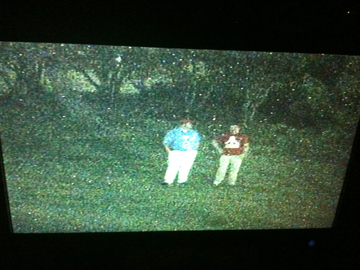
The night before ASIS began, FLIR held a press event at the Las Colinas Country Club in Irving, to showcase the company's color night-vision cameras.

FLIR acquired Salvador Imaging in June 2009, a manufacturer of high-performance CCD and electron multiplied CCD, or EMCCD, sensors for Department of Defense applications.

With the advanced EMCCD sensors, FLIR was able to integrate the technology to offer color night-vision cameras that provide high-quality color video in lighting conditions from full daylight to starlight, without extra lighting infrastructure. In fact, FLIR's color night vision cameras provide full-color video in lowlight conditions that render conventional CCD technologies useless.

In the demonstration, the company’s color night-vision camera was compared to a thermal imaging camera and a top-of-the-line Sony CCD camera. On a pitch-black golf course, with the color night vision camera, two men – one wearing a blue shirt and red cap and another wearing a red Atari shirt – are clearly visible. With the tradition thermal camera, you can see two men but no color details, and on the CCD camera, nothing can be seen.

Also notable was the announcement of security cameras that feature 640x480 resolution. The traditional resolution was 320x240. The combination of megapixel resolution and thermal imaging is new. These thermal cameras now offer 307,200 pixels as compared to the traditional 76,800 pixels, which equals to four times the resolution. And more pixels mean better image quality, longer detection ranges, enhanced background details and more cost effectiveness.

About the Author

Sherleen Mahoney is a Web managing editor at 1105 Media.

Featured

  • Security Industry Association Announces the 2026 Security Megatrends

    The Security Industry Association (SIA) has identified and forecasted the 2026 Security Megatrends, which form the basis of SIA’s signature annual Security Megatrends report defining the top 10 factors influencing both near- and long-term change in the global security industry. Read Now

  • The Future of Access Control: Cloud-Based Solutions for Safer Workplaces

    Access controls have revolutionized the way we protect our people, assets and operations. Gone are the days of cumbersome keychains and the security liabilities they introduced, but it’s a mistake to think that their evolution has reached its peak. Read Now

  • A Look at AI

    Large language models (LLMs) have taken the world by storm. Within months of OpenAI launching its AI chatbot, ChatGPT, it amassed more than 100 million users, making it the fastest-growing consumer application in history. Read Now

  • First, Do No Harm: Responsibly Applying Artificial Intelligence

    It was 2022 when early LLMs (Large Language Models) brought the term “AI” into mainstream public consciousness and since then, we’ve seen security corporations and integrators attempt to develop their solutions and sales pitches around the biggest tech boom of the 21st century. However, not all “artificial intelligence” is equally suitable for security applications, and it’s essential for end users to remain vigilant in understanding how their solutions are utilizing AI. Read Now

  • Improve Incident Response With Intelligent Cloud Video Surveillance

    Video surveillance is a vital part of business security, helping institutions protect against everyday threats for increased employee, customer, and student safety. However, many outdated surveillance solutions lack the ability to offer immediate insights into critical incidents. This slows down investigations and limits how effectively teams can respond to situations, creating greater risks for the organization. Read Now

New Products

  • HD2055 Modular Barricade

    Delta Scientific’s electric HD2055 modular shallow foundation barricade is tested to ASTM M50/P1 with negative penetration from the vehicle upon impact. With a shallow foundation of only 24 inches, the HD2055 can be installed without worrying about buried power lines and other below grade obstructions. The modular make-up of the barrier also allows you to cover wider roadways by adding additional modules to the system. The HD2055 boasts an Emergency Fast Operation of 1.5 seconds giving the guard ample time to deploy under a high threat situation.

  • Unified VMS

    AxxonSoft introduces version 2.0 of the Axxon One VMS. The new release features integrations with various physical security systems, making Axxon One a unified VMS. Other enhancements include new AI video analytics and intelligent search functions, hardened cybersecurity, usability and performance improvements, and expanded cloud capabilities

  • ResponderLink

    ResponderLink

    Shooter Detection Systems (SDS), an Alarm.com company and a global leader in gunshot detection solutions, has introduced ResponderLink, a groundbreaking new 911 notification service for gunshot events. ResponderLink completes the circle from detection to 911 notification to first responder awareness, giving law enforcement enhanced situational intelligence they urgently need to save lives. Integrating SDS’s proven gunshot detection system with Noonlight’s SendPolice platform, ResponderLink is the first solution to automatically deliver real-time gunshot detection data to 911 call centers and first responders. When shots are detected, the 911 dispatching center, also known as the Public Safety Answering Point or PSAP, is contacted based on the gunfire location, enabling faster initiation of life-saving emergency protocols.