Accessibility and Access Control
Matrix Systems helps a Minn. boy create the spy room of his dreams.
- By Laura Williams
- Jan 14, 2011
|
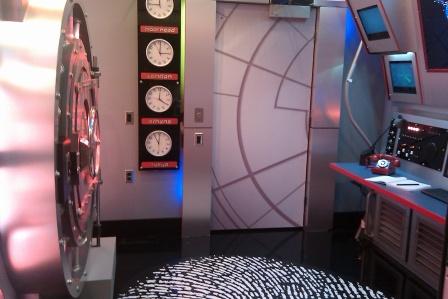
The completed secret room for the Grommesh family's 10-year-old son, which Matrix Systems outfitted with commercial video surveillance equipment from Dynex and Bosch for the Jan. 2 episode of Extreme Makeover: Home Edition. |
Access control systems are not typically fodder for prime-time television. But they played at least a supporting role recently when ABC’s Extreme Makeover: Home Edition starred a spy-loving 10-year-old who was given a “secret room,” complete with biometric fingerprint readers and a CCTV system.
In the show, which aired Jan. 2, Matrix Systems was able to outfit the Grommesh family’s new home with biometric access control and a CCTV system, which was much to espionage aficionado Garrett’s liking.
“All I need is a pair of shades, and I’m secret agent Garrett,” he said upon seeing the secret room for the first time.
And Garrett wasn’t the only one excited; Matrix’s John Birdwell and Jim Russell, who installed the equipment, were quite pleased as well.
“Everybody has seen the show, and being a part of doing something like this for somebody is pretty awesome,” Birdwell, a project manager, said.
“That little boy – you meet him and you think, ‘Wow, this kid’s really cool.’ Being involved like something like this, doing something for people, that was definitely one of our main motivators.”
Garrett has spina bifida and as a result must use a wheelchair. The show decided to feature his family because their old home was not wheelchair-friendly, preventing Garrett from being able to do everything he wanted. The new home is completely handicapped-accessible.

The show's technicians, under Birdwell's guidance, install commercial video surveillance monitors by Dynex with live feeds from Bosch PTZ cameras located throughout the house.
“Mom! I can do the dishes!” he exclaims. “I can get to my basement; I can get to the top floor; I can get everywhere.”
Matrix got involved in the effort when, a few months before the build, EMHM producer Sami Aziz approached the company after a Google search revealed Matrix among the top search results. Matrix was eager to help out.
“We have always dealt with the commercial side of the business,” said Russell, vice president of sales, “and we felt like this would allow us to use our skill sets to help a fantastic cause and family in a totally different setting.”
So they got to work, acquiring the products on short notice and traveling out to Moorehead, Minn., to get their hands dirty. Though Matrix typically does commercial installations – it has done a few private projects in the past for high-profile business owners and organizations like Ronald McDonald house – Birdwell said it wasn’t difficult to adapt the equipment for use in a smaller space. “The elevator that was involved in the home was not a standard-size elevator, so we had a confined space there,” he said. “But anytime you’re working in commercial applications, you still have to consider all the life safety issues and fire codes that you have to take into consideration in residential.”
The Matrix team worked with the same types of companies – elevator controllers and door operators, for example – that it does day-to-day in its commercial installations. “Besides the fast pace of this type of project, there’s not really a whole lot of difference,” Birdwell said.
And fast-paced it was. The EMHE team really does build an entire house in a week – 100 hours, to be exact. The crew, which comprised 3,000 to 4,000 volunteers with about 200 working at any given time, removed the original house from its foundation overnight and fully framed and roofed the new home by noon the next day.
When it was time for the electrical workers to get going, Matrix’s Russell and Birdwell, along with Kevin Kosch, a project engineer at integrator K.N.S. Services Inc., started working. “I don’t think in all of my experiences I have seen that many different types of cable being pulled by that many different people in so many directions, and yet it all terminated correctly!” Russell said. “It was the true definition of well-orchestrated chaos.”
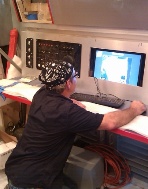
Armed with a set of instructions from Birdwell, EMHE's Paul DiMeo tests the video surveillance system during construction.
They installed two L-1 4G V-Station biometric fingerprint readers, one in the elevator door that leads into Garrett’s “secret spy room” and another on the entrance to the room from Garrett’s bedroom that activates a Stanley automatic sliding door. The spy room itself contains a bank of four, 15-inch Dynex security monitors wired to four Bosch auto-domed PTZ cameras. The cameras are installed in Garrett’s bedroom, the downstairs entryway, and entry and exit points in the front and back of the home. The whole system is managed with Bosch’s Vidos VMS.
Birdwell said it was not difficult to teach Garrett, and even his parents, how to use the equipment. When they were installing the fingerprint reader, the 10-year-old took quickly to the process. “We didn’t even have to tell him how to scan the second time around,” Birdwell said.
The Matrix employees said they would be interested in doing a project like this again. “We would absolutely do it again,” Russell said. “That being said, we learned an awful lot about how to do it differently if that possibility came. There is a tremendous amount of pressure to have this be perfect in the six days given you, and yes they do make many changes on the fly – but that just made it a little more fun!”