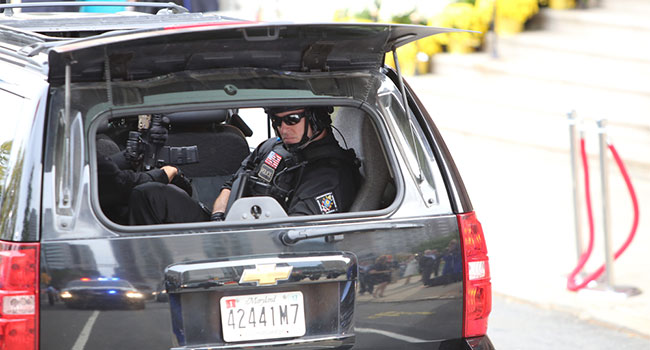
Keeping the Pope Secure on U.S. Soil

Keeping the Pope Secure on U.S. Soil

It’s not every day the Pope shows up for a visit, but when he does arrive in the United States, security is in the front of everyone’s mind.

In what was described as an unprecedented security effort, U.S. Immigration and Customs Enforcement’s (ICE) Homeland Security Investigations (HSI) was part of a massive detail during Pope Francis’ recent visit to the United States.

For six days, the pope’s first visit to U.S. soil took him to Washington, D.C., New York City and Philadelphia, where he visited the White House, U.S. Capitol, Madison Square Garden, Ground Zero, Independence Hall and several other stops in between. Millions of people lined the streets and filled venues just to get a glimpse on Pope Francis.

Prior to the pope’s arrival, Secretary of Homeland Security Jeh Johnson designated the visit as a National Special Security Event (NSSE) which allowed for enhanced cooperation of local, state and federal partners in establishing a safe and secure environment. The security portion of the operation was coordinated by the Secret Service, who combined its resources with HSI and other agencies. The FBI was the lead agency collecting intelligence, so that in the event of a crisis, the FBI would manage the response.

“Our efforts during the recent papal visit illustrate HSI’s commitment to working with our law enforcement partners to secure our homeland against all outside threats,” said Peter T. Edge, HSI executive associate director. “Our agents were prepared to execute every assignment given to them, and they did so with a pride and dignity that represented our agency well.”

For months, the Secret Service, HSI and other law enforcement partners worked together to ensure the safety of everyone who traveled near and far to see and hear the pope. Meetings were held, subcommittees were created and assignments were handed out to ensure that the Holy Father’s movements took place without a hitch.

Featured

New Products

  • Camden CM-221 Series Switches

    Camden CM-221 Series Switches

    Camden Door Controls is pleased to announce that, in response to soaring customer demand, it has expanded its range of ValueWave™ no-touch switches to include a narrow (slimline) version with manual override. This override button is designed to provide additional assurance that the request to exit switch will open a door, even if the no-touch sensor fails to operate. This new slimline switch also features a heavy gauge stainless steel faceplate, a red/green illuminated light ring, and is IP65 rated, making it ideal for indoor or outdoor use as part of an automatic door or access control system. ValueWave™ no-touch switches are designed for easy installation and trouble-free service in high traffic applications. In addition to this narrow version, the CM-221 & CM-222 Series switches are available in a range of other models with single and double gang heavy-gauge stainless steel faceplates and include illuminated light rings.

  • FEP GameChanger

    FEP GameChanger

    Paige Datacom Solutions Introduces Important and Innovative Cabling Products GameChanger Cable, a proven and patented solution that significantly exceeds the reach of traditional category cable will now have a FEP/FEP construction.

  • ResponderLink

    ResponderLink

    Shooter Detection Systems (SDS), an Alarm.com company and a global leader in gunshot detection solutions, has introduced ResponderLink, a groundbreaking new 911 notification service for gunshot events. ResponderLink completes the circle from detection to 911 notification to first responder awareness, giving law enforcement enhanced situational intelligence they urgently need to save lives. Integrating SDS’s proven gunshot detection system with Noonlight’s SendPolice platform, ResponderLink is the first solution to automatically deliver real-time gunshot detection data to 911 call centers and first responders. When shots are detected, the 911 dispatching center, also known as the Public Safety Answering Point or PSAP, is contacted based on the gunfire location, enabling faster initiation of life-saving emergency protocols.