Hawaii

Hawaii's False Alarm Leads to Changes in Emergency Communication Systems

On Saturday, people in Hawaii received an emergency notification warning of an imminent nuclear missile attack.

For nearly an entire hour on Saturday, the people of Hawaii prepared for the worst. Parents called their children, students ran for the nearest underground shelter and families hid in their bathtubs and basements after receiving an emergency notification from the Hawaii Emergency Management Agency (HEMA) that a "ballistic missile threat" was inbound to the state.
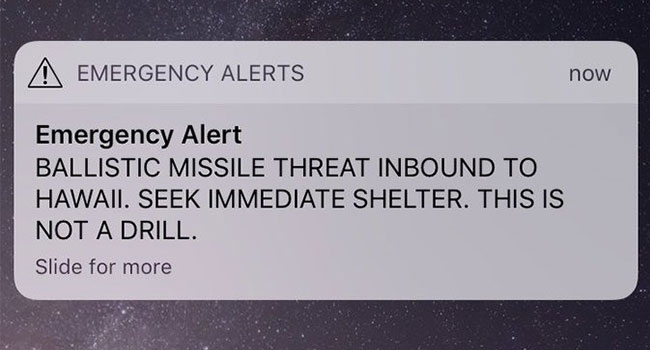
Thirty-eight minutes later, they received another notification. This time, the message informed Hawaiians that the missile threat was a "false alarm."

In the hours after the false alarm notification, HEMA explained the whole ordeal was a simple mistake made by an employee during a shift change.

On Sunday, Federal Communications Commissions Chairman Ajit Pai called the false alert, "absolutely unacceptable" and said a full investigation was "well underway."

"Based on the information we have collected so far, it appears that the government of Hawaii did not have reasonable safeguards or process controls in place to prevent the transmission of a false alert," Pai said in a statement. "Federal, state and local officials throughout the country need to work together to identify any vulnerabilities to false alerts and do what's necessary to fix them. We also must ensure that corrections are issued immediately in the event that a false alarm goes out."

Wireless emergency alerts are typically dispatched during emergency situations - to warn the public of dangerous weather, missing children, and security threats - and are a partnership of the FCC, FEMA and the wireless industry. While the FCC establishes rules and regulations surrounding emergency alerting, responsibility for sending those messages typically falls to emergency management officials, according to The Washington Post.

The situation on Saturday was worsened when Hawaii officials realized that there was no system in place at the state emergency agency for correcting the error. The state agency had standing permission through FEMA to use civil warning systems to send out the missile alert, but not to send out a subsequent false alarm notification.

"We had to double back and work with FEMA [to carft and approve the false alarm alert] and that's what took time," HEMA spokesperson Richard Rapoza said.

Rapoza said that has since been fixed with a cancellation option that can be triggered within seconds of the mistake.

"In the past there was no cancellation button," Rapoza said. "There was no false alarm button at all. Now there is a command to issue a message immediately that goes over on the same system saying 'It's a false alarm. Please disregard.' as soon as the mistake is identified."

The HEMA said it has also suspended all internal drills until the investigation is completed. In addition, it has put in place a "two-person activation/verification" rule for tests and actual missile launch notifications.

“Part of the problem was it was too easy — for anyone — to make such a big mistake,” Rapoza said. “We have to make sure that we’re not looking for retribution, but we should be fixing the problems in the system. . . . I know that it’s a very, very difficult situation for him.”

The employee has since been reassigned to a new position at HEMA.


About the Author

Sydny Shepard is the Executive Editor of Campus Security & Life Safety.

Featured

  • The Future of Access Control: Cloud-Based Solutions for Safer Workplaces

    Access controls have revolutionized the way we protect our people, assets and operations. Gone are the days of cumbersome keychains and the security liabilities they introduced, but it’s a mistake to think that their evolution has reached its peak. Read Now

  • A Look at AI

    Large language models (LLMs) have taken the world by storm. Within months of OpenAI launching its AI chatbot, ChatGPT, it amassed more than 100 million users, making it the fastest-growing consumer application in history. Read Now

  • First, Do No Harm: Responsibly Applying Artificial Intelligence

    It was 2022 when early LLMs (Large Language Models) brought the term “AI” into mainstream public consciousness and since then, we’ve seen security corporations and integrators attempt to develop their solutions and sales pitches around the biggest tech boom of the 21st century. However, not all “artificial intelligence” is equally suitable for security applications, and it’s essential for end users to remain vigilant in understanding how their solutions are utilizing AI. Read Now

  • Improve Incident Response With Intelligent Cloud Video Surveillance

    Video surveillance is a vital part of business security, helping institutions protect against everyday threats for increased employee, customer, and student safety. However, many outdated surveillance solutions lack the ability to offer immediate insights into critical incidents. This slows down investigations and limits how effectively teams can respond to situations, creating greater risks for the organization. Read Now

  • Security Today Announces 2025 CyberSecured Award Winners

    Security Today is pleased to announce the 2025 CyberSecured Awards winners. Sixteen companies are being recognized this year for their network products and other cybersecurity initiatives that secure our world today. Read Now

New Products

  • ResponderLink

    ResponderLink

    Shooter Detection Systems (SDS), an Alarm.com company and a global leader in gunshot detection solutions, has introduced ResponderLink, a groundbreaking new 911 notification service for gunshot events. ResponderLink completes the circle from detection to 911 notification to first responder awareness, giving law enforcement enhanced situational intelligence they urgently need to save lives. Integrating SDS’s proven gunshot detection system with Noonlight’s SendPolice platform, ResponderLink is the first solution to automatically deliver real-time gunshot detection data to 911 call centers and first responders. When shots are detected, the 911 dispatching center, also known as the Public Safety Answering Point or PSAP, is contacted based on the gunfire location, enabling faster initiation of life-saving emergency protocols.

  • AC Nio

    AC Nio

    Aiphone, a leading international manufacturer of intercom, access control, and emergency communication products, has introduced the AC Nio, its access control management software, an important addition to its new line of access control solutions.

  • Mobile Safe Shield

    Mobile Safe Shield

    SafeWood Designs, Inc., a manufacturer of patented bullet resistant products, is excited to announce the launch of the Mobile Safe Shield. The Mobile Safe Shield is a moveable bullet resistant shield that provides protection in the event of an assailant and supplies cover in the event of an active shooter. With a heavy-duty steel frame, quality castor wheels, and bullet resistant core, the Mobile Safe Shield is a perfect addition to any guard station, security desks, courthouses, police stations, schools, office spaces and more. The Mobile Safe Shield is incredibly customizable. Bullet resistant materials are available in UL 752 Levels 1 through 8 and include glass, white board, tack board, veneer, and plastic laminate. Flexibility in bullet resistant materials allows for the Mobile Safe Shield to blend more with current interior décor for a seamless design aesthetic. Optional custom paint colors are also available for the steel frame.