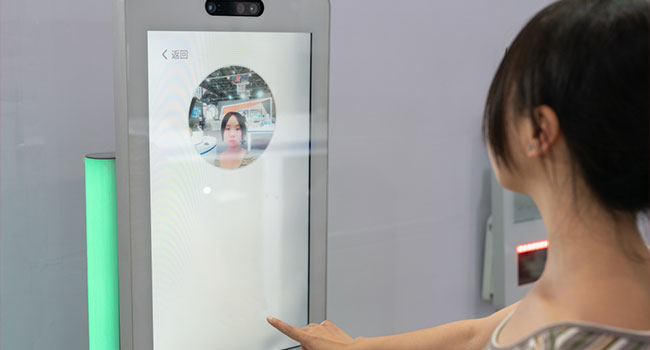
chinese facial recognition phone

China Implements Mandatory Facial Recognition Scans For New Cell Phone Users

The government claims that the new requirement will prevent fraud for citizens, but critics see it as the furthering of invasive surveillance measures.

All new cell phone users in China must submit a facial scan to the country’s technology agency after new regulations went into effect on Sunday.

The government’s Ministry of Industry and Information Technology said that the new requirement, which will not affect phone numbers already registered before Dec. 1, is meant to protect Chinese citizens’ “legitimate rights and interests in cyberspace,” according to CNN.

Officials say that the regulations will prevent fraud, but critics see the measure as yet another way that Chinese officials are removing anonymity from the internet and conducting more intense surveillance of users.

"There's no evidence that this type of technology improves public safety, but it's ideal for authoritarian control," Evan Greer, the deputy director of Fight for the Future, a digital rights advocacy group, told ABC News. “It enables governments to engage in invasive and ubiquitous monitoring of an entire population.”

More than 850 million people in China, or about 65 percent of the population, use mobile phones to access the internet, CNN reported. The government has essentially built its own, censored version of messaging, social networking and financial apps that are used by most of the population.

“Real-name registration” policies are already enforced in the country, requiring Chinese citizens to link their online accounts with their government identifications. This new deployment of facial recognition only furthers the level of knowledge that the government has of its citizens’ online activity.

Read more: China Installs Secret App to Travelers’ Phones to Monitor For ‘Objectionable Material’

Facial recognition is also widely used across China, particularly in public spaces like airports, streets, office buildings and more. The Chinese government did not say which technology providers would provide the service to cell phone companies, though the country is home to several providers of facial recognition, including SenseTime and Megvii.

"China's implementation of this technology should be a wake-up call to people everywhere who care about basic human liberty," Greer said.

About the Author

Haley Samsel is an Associate Content Editor for the Infrastructure Solutions Group at 1105 Media.

Featured

  • The Future of Access Control: Cloud-Based Solutions for Safer Workplaces

    Access controls have revolutionized the way we protect our people, assets and operations. Gone are the days of cumbersome keychains and the security liabilities they introduced, but it’s a mistake to think that their evolution has reached its peak. Read Now

  • A Look at AI

    Large language models (LLMs) have taken the world by storm. Within months of OpenAI launching its AI chatbot, ChatGPT, it amassed more than 100 million users, making it the fastest-growing consumer application in history. Read Now

  • First, Do No Harm: Responsibly Applying Artificial Intelligence

    It was 2022 when early LLMs (Large Language Models) brought the term “AI” into mainstream public consciousness and since then, we’ve seen security corporations and integrators attempt to develop their solutions and sales pitches around the biggest tech boom of the 21st century. However, not all “artificial intelligence” is equally suitable for security applications, and it’s essential for end users to remain vigilant in understanding how their solutions are utilizing AI. Read Now

  • Improve Incident Response With Intelligent Cloud Video Surveillance

    Video surveillance is a vital part of business security, helping institutions protect against everyday threats for increased employee, customer, and student safety. However, many outdated surveillance solutions lack the ability to offer immediate insights into critical incidents. This slows down investigations and limits how effectively teams can respond to situations, creating greater risks for the organization. Read Now

  • Security Today Announces 2025 CyberSecured Award Winners

    Security Today is pleased to announce the 2025 CyberSecured Awards winners. Sixteen companies are being recognized this year for their network products and other cybersecurity initiatives that secure our world today. Read Now

New Products

  • Automatic Systems V07

    Automatic Systems V07

    Automatic Systems, an industry-leading manufacturer of pedestrian and vehicle secure entrance control access systems, is pleased to announce the release of its groundbreaking V07 software. The V07 software update is designed specifically to address cybersecurity concerns and will ensure the integrity and confidentiality of Automatic Systems applications. With the new V07 software, updates will be delivered by means of an encrypted file.

  • AC Nio

    AC Nio

    Aiphone, a leading international manufacturer of intercom, access control, and emergency communication products, has introduced the AC Nio, its access control management software, an important addition to its new line of access control solutions.

  • Camden CV-7600 High Security Card Readers

    Camden CV-7600 High Security Card Readers

    Camden Door Controls has relaunched its CV-7600 card readers in response to growing market demand for a more secure alternative to standard proximity credentials that can be easily cloned. CV-7600 readers support MIFARE DESFire EV1 & EV2 encryption technology credentials, making them virtually clone-proof and highly secure.