Military Creates New “Iron Man” Suit

Military Creates New “Iron Man” Suit

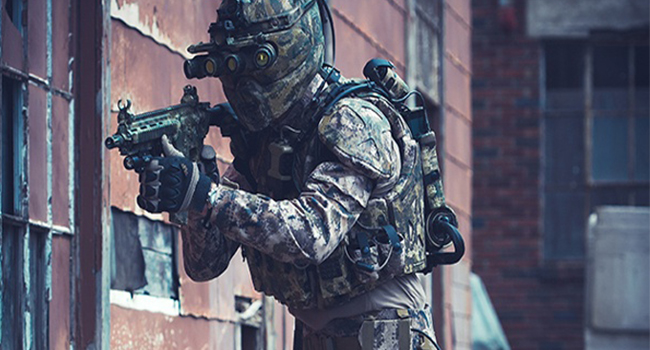
The U.S. military is closer than ever to putting Iron Man on the front lines, or at least something that closely mirrors the superhero’s tech-forward suit of armor, CNN reported.

Unlike Hollywood’s, the suit won’t give its operator the ability to fly, but the real-life body armor may have one leg up on the fictional version: The military’s suit will be made of liquid armor that can solidify on command.

Fitted with protective gear, the Tactical Assault Light Operator Suit, or TALOS, troops would be more lethal and better protected, particularly the vulnerable first soldier to breach compound.

Plenty of academics, defense industry experts and Pentagon personnel are trying to fine-tune the battery-powered exoskeleton, which would reduce strain on the body, provide superior ballistic protection and in-helmet technologies to boost communications and visibility.

Pentagon spokesman Lt. Cmdr. Matt Allen said the Defense Department does “not know how much TALOS will cost,” saying only that the Special Operations Command “has resourced an adequate amount of funds” to develop the suit.

The TALOS program has completed several prototypes and is on track to deliver a first-generation suit by August 2018.

About the Author

Sydny Shepard is the Executive Editor of Campus Security & Life Safety.

Featured

  • Improve Incident Response With Intelligent Cloud Video Surveillance

    Video surveillance is a vital part of business security, helping institutions protect against everyday threats for increased employee, customer, and student safety. However, many outdated surveillance solutions lack the ability to offer immediate insights into critical incidents. This slows down investigations and limits how effectively teams can respond to situations, creating greater risks for the organization. Read Now

  • Security Today Announces 2025 CyberSecured Award Winners

    Security Today is pleased to announce the 2025 CyberSecured Awards winners. Sixteen companies are being recognized this year for their network products and other cybersecurity initiatives that secure our world today. Read Now

  • Empowering and Securing a Mobile Workforce

    What happens when technology lets you work anywhere – but exposes you to security threats everywhere? This is the reality of modern work. No longer tethered to desks, work happens everywhere – in the office, from home, on the road, and in countless locations in between. Read Now

  • TSA Introduces New $45 Fee Option for Travelers Without REAL ID Starting February 1

    The Transportation Security Administration (TSA) announced today that it will refer all passengers who do not present an acceptable form of ID and still want to fly an option to pay a $45 fee to use a modernized alternative identity verification system, TSA Confirm.ID, to establish identity at security checkpoints beginning on February 1, 2026. Read Now

  • The Evolution of IP Camera Intelligence

    As the 30th anniversary of the IP camera approaches in 2026, it is worth reflecting on how far we have come. The first network camera, launched in 1996, delivered one frame every 17 seconds—not impressive by today’s standards, but groundbreaking at the time. It did something that no analog system could: transmit video over a standard IP network. Read Now

New Products

  • Compact IP Video Intercom

    Viking’s X-205 Series of intercoms provide HD IP video and two-way voice communication - all wrapped up in an attractive compact chassis.

  • 4K Video Decoder

    3xLOGIC’s VH-DECODER-4K is perfect for use in organizations of all sizes in diverse vertical sectors such as retail, leisure and hospitality, education and commercial premises.

  • A8V MIND

    A8V MIND

    Hexagon’s Geosystems presents a portable version of its Accur8vision detection system. A rugged all-in-one solution, the A8V MIND (Mobile Intrusion Detection) is designed to provide flexible protection of critical outdoor infrastructure and objects. Hexagon’s Accur8vision is a volumetric detection system that employs LiDAR technology to safeguard entire areas. Whenever it detects movement in a specified zone, it automatically differentiates a threat from a nonthreat, and immediately notifies security staff if necessary. Person detection is carried out within a radius of 80 meters from this device. Connected remotely via a portable computer device, it enables remote surveillance and does not depend on security staff patrolling the area.