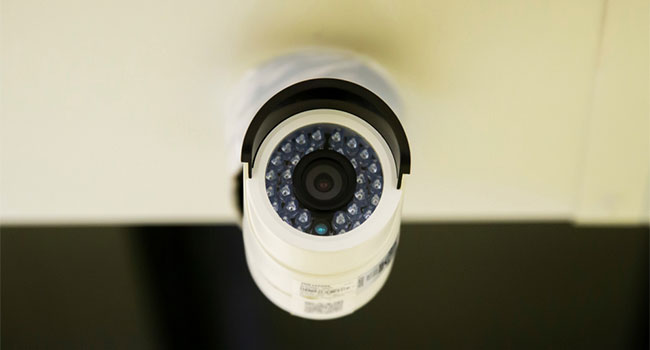
video surveillance camera

Security Tech Company Raided, Charged With Selling Chinese-Made Equipment to Federal Agencies

Seven current and former employees at Aventura Technologies are facing federal charges for falsely claiming their products were manufactured in the U.S.

A New York-based security technology company and seven current and former senior employees have been charged with fraud, money laundering and illegal importation of Chinese-manufactured equipment, the Justice Department announced on Thursday.

The headquarters of Aventura Technologies was raided on Thursday after federal agents arrested senior executives, current and former employees, and the owners of the company, Jack Cabasso and his wife Frances Cabasso. The raid on Long Island involved dozens of investigators who hauled away containers of equipment from the facility, NBC News reported.

All seven Aventura employees were charged with selling Chinese-made equipment that they claimed was made in the U.S. to clients that included the U.S. Air Force, the Navy and the Department of Energy. The surveillance equipment had “known cybersecurity vulnerability to government and private customers,” according to a press release from the U.S. Attorney’s Office for the Eastern District of New York.


“The defendants falsely claimed for years that their surveillance and security equipment was manufactured on Long Island, padding their pockets with money from lucrative contracts without regard for the risk to our country’s national security posed by secretly peddling made-in-China electronics with known cyber vulnerabilities,” U.S. Attorney Richard P. Donoghue said in a statement.

Donoghue added: “They will face serious consequences for slapping phony ‘Made in the U.S.A.’ labels on products that our armed forces and other sensitive government facilities depended upon.”

The scheme had been ongoing since 2006, seven years after Aventura opened in 1999, according to the attorney’s office. The company offered a variety of security services and products, ranging from video surveillance management and facial recognition software to turnstiles and body scanners.

Four of the employees were also charged with defrauding the government by claiming that Frances Cabasso was the owner and operator of the company. While Jack Cabasso’s official title was managing director, he was Aventura’s de facto owner, not his wife, according to the federal complaint.

The company said that Frances was the owner so Aventura could obtain access to “valuable government contracts reserved for women-owned businesses,” according to the attorney’s office press release. The Cabassos are also charged with laundering the monetary proceeds of the schemes.

Six defendants were arrested on Thursday morning, and the government has frozen approximately $3 million in 12 financial accounts containing proceeds from the defendants.

“Greed is at the heart of this scheme, a reprehensible motive when the subjects in this case allegedly put into question the security of men and women who don uniforms each day to protect our nation,” FBI Assistant Director-in-Charge William Sweeney said in a statement. “There is no mistaking the cyber vulnerabilities created when this company sold electronic surveillance products made in [China], and then using those items in our government agencies and the branches of our armed forces.”

The Security Industry Association, of which Aventura is a member, issued a statement Thursday evening saying that SIA finds the charges "very serious" and represents business practices that SIA "does not condone." 

"SIA strongly encourages its members to operate ethically and comply with all U.S. laws and regulations," the association said. "The SIA Board of Directors has begun to review these charges and the status of Aventura’s membership in SIA."

About the Author

Haley Samsel is an Associate Content Editor for the Infrastructure Solutions Group at 1105 Media.

Featured

  • Brivo, Eagle Eye Networks Merge

    Dean Drako, Chairman of Brivo, the leading global provider of cloud-native access control and smart space technologies, and Founder of Eagle Eye Networks, the global leader in cloud AI video surveillance, today announced the two companies will merge, creating the world’s largest AI cloud-native physical security company. The merged company will operate under the Brivo name and deliver a truly unified cloud-native security platform. Read Now

  • Security Industry Association Announces the 2026 Security Megatrends

    The Security Industry Association (SIA) has identified and forecasted the 2026 Security Megatrends, which form the basis of SIA’s signature annual Security Megatrends report defining the top 10 factors influencing both near- and long-term change in the global security industry. Read Now

  • The Future of Access Control: Cloud-Based Solutions for Safer Workplaces

    Access controls have revolutionized the way we protect our people, assets and operations. Gone are the days of cumbersome keychains and the security liabilities they introduced, but it’s a mistake to think that their evolution has reached its peak. Read Now

  • A Look at AI

    Large language models (LLMs) have taken the world by storm. Within months of OpenAI launching its AI chatbot, ChatGPT, it amassed more than 100 million users, making it the fastest-growing consumer application in history. Read Now

  • First, Do No Harm: Responsibly Applying Artificial Intelligence

    It was 2022 when early LLMs (Large Language Models) brought the term “AI” into mainstream public consciousness and since then, we’ve seen security corporations and integrators attempt to develop their solutions and sales pitches around the biggest tech boom of the 21st century. However, not all “artificial intelligence” is equally suitable for security applications, and it’s essential for end users to remain vigilant in understanding how their solutions are utilizing AI. Read Now

New Products

  • Luma x20

    Luma x20

    Snap One has announced its popular Luma x20 family of surveillance products now offers even greater security and privacy for home and business owners across the globe by giving them full control over integrators’ system access to view live and recorded video. According to Snap One Product Manager Derek Webb, the new “customer handoff” feature provides enhanced user control after initial installation, allowing the owners to have total privacy while also making it easy to reinstate integrator access when maintenance or assistance is required. This new feature is now available to all Luma x20 users globally. “The Luma x20 family of surveillance solutions provides excellent image and audio capture, and with the new customer handoff feature, it now offers absolute privacy for camera feeds and recordings,” Webb said. “With notifications and integrator access controlled through the powerful OvrC remote system management platform, it’s easy for integrators to give their clients full control of their footage and then to get temporary access from the client for any troubleshooting needs.”

  • AC Nio

    AC Nio

    Aiphone, a leading international manufacturer of intercom, access control, and emergency communication products, has introduced the AC Nio, its access control management software, an important addition to its new line of access control solutions.

  • ResponderLink

    ResponderLink

    Shooter Detection Systems (SDS), an Alarm.com company and a global leader in gunshot detection solutions, has introduced ResponderLink, a groundbreaking new 911 notification service for gunshot events. ResponderLink completes the circle from detection to 911 notification to first responder awareness, giving law enforcement enhanced situational intelligence they urgently need to save lives. Integrating SDS’s proven gunshot detection system with Noonlight’s SendPolice platform, ResponderLink is the first solution to automatically deliver real-time gunshot detection data to 911 call centers and first responders. When shots are detected, the 911 dispatching center, also known as the Public Safety Answering Point or PSAP, is contacted based on the gunfire location, enabling faster initiation of life-saving emergency protocols.