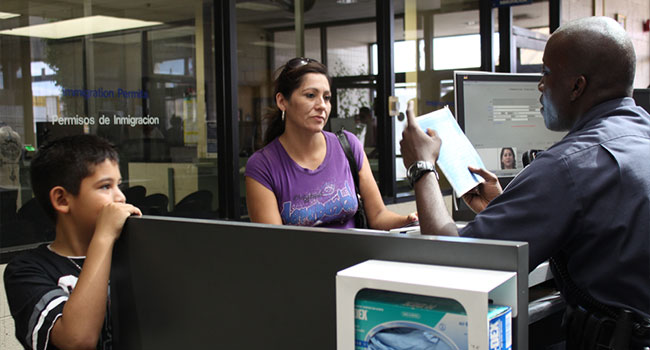
port of entry and customs agent

Federal Court Rules That Warrantless Device Searches at Airports, Ports of Entry Violate Fourth Amendment

Under the terms of the ruling, border agents must demonstrate “individualized suspicion” of international travelers before officials can seize and search an electronic device.

Warrantless government searches of phones and laptops of international travelers at airports and American ports of entry are violations of the Fourth Amendment, a federal court in Boston ruled on Tuesday.

In 2017, the American Civil Liberties Union and the Electronic Frontier Foundation filed a lawsuit on behalf of 11 people whose devices were searched without warrants or “individualized suspicion” as they attempted to enter the United States. Ten of the travelers were American citizens, and one was a permanent U.S. resident, The Associated Press reported.

The court decision comes as the number of device searches at ports of entry has increased significantly. In 2018, the ACLU found that the federal government conducted more than 33,000 such searches, which was nearly four times the number of searches in 2015.

While the federal government has called the searches a crucial method to protect Americans from international and domestic threats, the ACLU and other advocacy groups have argued that they violate the rights of international travelers. Under the ruling, border officials would have to demonstrate “individualized suspicion of contraband before they can search a traveler’s device,” according to the ACLU.

“This ruling significantly advances Fourth Amendment protections for the millions of international travelers who enter the United States every year,” Esha Bhandari, staff attorney with the ACLU’s Speech, Privacy, and Technology Project, said in a statement. “By putting an end to the government’s ability to conduct suspicionless fishing expeditions, the court reaffirms that the border is not a lawless place and that we don’t lose our privacy rights when we travel.”

In previous statements about the lawsuit, the Department of Homeland Security said that all travelers, regardless of citizenship status, was subject to search by customs officers. They argue that important evidence of human trafficking, terrorism and intellectural property rights violations have been discovered as a result of the searches, according to the Associated Press.

However, the ACLU and other critics say that DHS officials’ targeting was too broad because officers were not only searching laptops and phones of targeted individuals but their associates, friends and families. Other searches were random, according to the DHS.

“This is a great day for travelers who now can cross the international border without fear that the government will, in the absence of any suspicion, ransack the extraordinarily sensitive information we all carry in our electronic devices," Sophia Cope, EFF senior staff attorney, said in a statement.

U.S. government officials have yet to make public statements on the ruling or if there are plans to appeal.

About the Author

Haley Samsel is an Associate Content Editor for the Infrastructure Solutions Group at 1105 Media.

Featured

  • Improve Incident Response With Intelligent Cloud Video Surveillance

    Video surveillance is a vital part of business security, helping institutions protect against everyday threats for increased employee, customer, and student safety. However, many outdated surveillance solutions lack the ability to offer immediate insights into critical incidents. This slows down investigations and limits how effectively teams can respond to situations, creating greater risks for the organization. Read Now

  • Security Today Announces 2025 CyberSecured Award Winners

    Security Today is pleased to announce the 2025 CyberSecured Awards winners. Sixteen companies are being recognized this year for their network products and other cybersecurity initiatives that secure our world today. Read Now

  • Empowering and Securing a Mobile Workforce

    What happens when technology lets you work anywhere – but exposes you to security threats everywhere? This is the reality of modern work. No longer tethered to desks, work happens everywhere – in the office, from home, on the road, and in countless locations in between. Read Now

  • TSA Introduces New $45 Fee Option for Travelers Without REAL ID Starting February 1

    The Transportation Security Administration (TSA) announced today that it will refer all passengers who do not present an acceptable form of ID and still want to fly an option to pay a $45 fee to use a modernized alternative identity verification system, TSA Confirm.ID, to establish identity at security checkpoints beginning on February 1, 2026. Read Now

  • The Evolution of IP Camera Intelligence

    As the 30th anniversary of the IP camera approaches in 2026, it is worth reflecting on how far we have come. The first network camera, launched in 1996, delivered one frame every 17 seconds—not impressive by today’s standards, but groundbreaking at the time. It did something that no analog system could: transmit video over a standard IP network. Read Now

New Products

  • Mobile Safe Shield

    Mobile Safe Shield

    SafeWood Designs, Inc., a manufacturer of patented bullet resistant products, is excited to announce the launch of the Mobile Safe Shield. The Mobile Safe Shield is a moveable bullet resistant shield that provides protection in the event of an assailant and supplies cover in the event of an active shooter. With a heavy-duty steel frame, quality castor wheels, and bullet resistant core, the Mobile Safe Shield is a perfect addition to any guard station, security desks, courthouses, police stations, schools, office spaces and more. The Mobile Safe Shield is incredibly customizable. Bullet resistant materials are available in UL 752 Levels 1 through 8 and include glass, white board, tack board, veneer, and plastic laminate. Flexibility in bullet resistant materials allows for the Mobile Safe Shield to blend more with current interior décor for a seamless design aesthetic. Optional custom paint colors are also available for the steel frame.

  • ResponderLink

    ResponderLink

    Shooter Detection Systems (SDS), an Alarm.com company and a global leader in gunshot detection solutions, has introduced ResponderLink, a groundbreaking new 911 notification service for gunshot events. ResponderLink completes the circle from detection to 911 notification to first responder awareness, giving law enforcement enhanced situational intelligence they urgently need to save lives. Integrating SDS’s proven gunshot detection system with Noonlight’s SendPolice platform, ResponderLink is the first solution to automatically deliver real-time gunshot detection data to 911 call centers and first responders. When shots are detected, the 911 dispatching center, also known as the Public Safety Answering Point or PSAP, is contacted based on the gunfire location, enabling faster initiation of life-saving emergency protocols.

  • EasyGate SPT and SPD

    EasyGate SPT SPD

    Security solutions do not have to be ordinary, let alone unattractive. Having renewed their best-selling speed gates, Cominfo has once again demonstrated their Art of Security philosophy in practice — and confirmed their position as an industry-leading manufacturers of premium speed gates and turnstiles.