drone airport

Congressmen Protest TSA Plan to Shoot Down Drones Near Airports

Two House members say the Department of Homeland Security does not have enough authority to deploy defense equipment to take down drones.

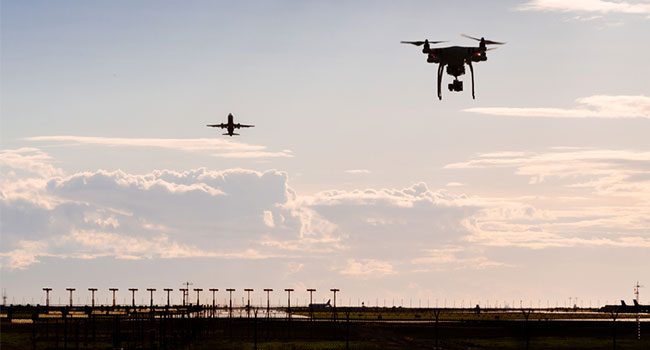
Facing a growing number of unauthorized drones flying near airports, the Transportation Security Administration wants to give air marshals the ability to use equipment from the Defense Department to take them down.

But two Republican congressmen are speaking out against the plan, sending a letter to the Department of Homeland Security asking the agency to rethink the idea of empowering non-defense professionals to shoot down small aircraft, which often cause issues for pilots and passengers alike.

Reps. Sam Graves (R-Mo.) and Mike Rogers (R-Ala.), who serve as the top Republicans on the House Transportation and Homeland Security committees respectively, said the DHS plan is not within the scope of powers given to the DHS to counter drones, The Washington Post reported.

“While we share the goal of ensuring that our nation’s airports are not disrupted by negligent or nefarious [unmanned aircraft system] operations, DHS does not have the authority or the experience necessary to operate [counter-unmanned aircraft system] equipment in the manner proposed,” the congressmen wrote in a Nov. 14 letter to DHS Acting Secretary Chad Wolf.

In a statement, the pair said that the only federal agency that understands the complexity of the American flight system is the Federal Aviation Administration, deeming the TSA incapable of taking down drones without disrupting the system.

“Nobody wants drones to cause disruptions at our airports, but to hastily hand over authority to shoot down drones to an agency that doesn’t have the critical knowledge or experience of how our airspace system functions is irresponsible and dangerous,” Graves and Rogers said.

There is little information available about the weapons that the DHS is proposing to use against unmanned aircraft systems, or drones. The Post reported that at the United Nations General Assembly in New York this fall, the Secret Service and Coast Guard tested counter-drone technology. Officials said that the weapons would potentially detect radio signals, locate pilots or disrupt and disable drones.

In their letter to Wolf, Graves and Rogers added that the administration should indicate if another federal agency needs additional authority to address credible drone threats near airports.

“We welcome any discussion along those lines in order to keep our National Airspace System safe and our homeland secure,” they said.

About the Author

Haley Samsel is an Associate Content Editor for the Infrastructure Solutions Group at 1105 Media.

Featured

  • Security Today Announces 2025 CyberSecured Award Winners

    Security Today is pleased to announce the 2025 CyberSecured Awards winners. Sixteen companies are being recognized this year for their network products and other cybersecurity initiatives that secure our world today. Read Now

  • Empowering and Securing a Mobile Workforce

    What happens when technology lets you work anywhere – but exposes you to security threats everywhere? This is the reality of modern work. No longer tethered to desks, work happens everywhere – in the office, from home, on the road, and in countless locations in between. Read Now

  • TSA Introduces New $45 Fee Option for Travelers Without REAL ID Starting February 1

    The Transportation Security Administration (TSA) announced today that it will refer all passengers who do not present an acceptable form of ID and still want to fly an option to pay a $45 fee to use a modernized alternative identity verification system, TSA Confirm.ID, to establish identity at security checkpoints beginning on February 1, 2026. Read Now

  • The Evolution of IP Camera Intelligence

    As the 30th anniversary of the IP camera approaches in 2026, it is worth reflecting on how far we have come. The first network camera, launched in 1996, delivered one frame every 17 seconds—not impressive by today’s standards, but groundbreaking at the time. It did something that no analog system could: transmit video over a standard IP network. Read Now

  • From Surveillance to Intelligence

    Years ago, it would have been significantly more expensive to run an analytic like that — requiring a custom-built solution with burdensome infrastructure demands — but modern edge devices have made it accessible to everyone. It also saves time, which is a critical factor if a missing child is involved. Video compression technology has played a critical role as well. Over the years, significant advancements have been made in video coding standards — including H.263, MPEG formats, and H.264—alongside compression optimization technologies developed by IP video manufacturers to improve efficiency without sacrificing quality. The open-source AV1 codec developed by the Alliance for Open Media—a consortium including Google, Netflix, Microsoft, Amazon and others — is already the preferred decoder for cloud-based applications, and is quickly becoming the standard for video compression of all types. Read Now

New Products

  • Camden CV-7600 High Security Card Readers

    Camden CV-7600 High Security Card Readers

    Camden Door Controls has relaunched its CV-7600 card readers in response to growing market demand for a more secure alternative to standard proximity credentials that can be easily cloned. CV-7600 readers support MIFARE DESFire EV1 & EV2 encryption technology credentials, making them virtually clone-proof and highly secure.

  • QCS7230 System-on-Chip (SoC)

    QCS7230 System-on-Chip (SoC)

    The latest Qualcomm® Vision Intelligence Platform offers next-generation smart camera IoT solutions to improve safety and security across enterprises, cities and spaces. The Vision Intelligence Platform was expanded in March 2022 with the introduction of the QCS7230 System-on-Chip (SoC), which delivers superior artificial intelligence (AI) inferencing at the edge.

  • HD2055 Modular Barricade

    Delta Scientific’s electric HD2055 modular shallow foundation barricade is tested to ASTM M50/P1 with negative penetration from the vehicle upon impact. With a shallow foundation of only 24 inches, the HD2055 can be installed without worrying about buried power lines and other below grade obstructions. The modular make-up of the barrier also allows you to cover wider roadways by adding additional modules to the system. The HD2055 boasts an Emergency Fast Operation of 1.5 seconds giving the guard ample time to deploy under a high threat situation.