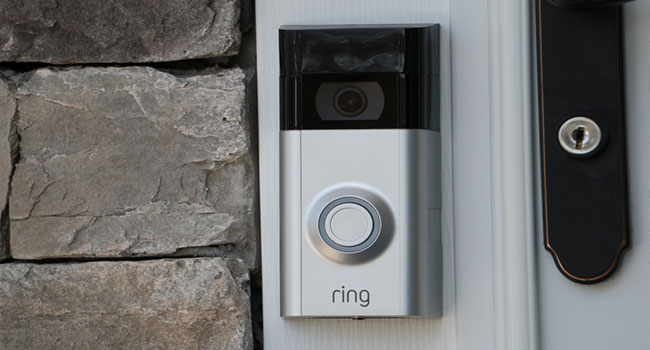
ring doorbell camera

Ring Announces New Security Protocols After Customer Complaints of Account Hacks

The security company is making two-factor authentication mandatory and is considering allowing users to opt out of sharing their data with third-party companies.

In response to highly publicized complaints from customers about their Ring cameras being hacked, the Amazon-owned company announced new security protocols on Tuesday that will make their products more secure for customers.

Ring is now making two-factor authentication mandatory for all users when they log into their accounts. Each time a customer logs in, the company will send a code through an email or phone number associated with the account. The six-digit code -- which many consumers have become familiar with through other websites -- will add an extra layer of security to Ring accounts, making it harder for hackers to gain control of the account and its devices.

“Your account safety and security is our priority,” Leila Rouhi, the president of Ring, said in a statement. “We will stay vigilant and continue to give you more transparency and control over your devices and personal information, and help keep your home and Ring account secure and protected.”

In addition to the mandatory two-factor, Ring pointed to steps it had already taken to make accounts more secure. Since December, users have been notified with each new login attempt, which can help customers figure out if the login is coming from a suspicious source.

The company also addressed criticisms that it was sharing user data with third-party marketing companies, a fact discovered by security researchers last month. Those third parties included Facebook. Now, Ring says that it will “temporarily” pause the use of “most third-party analytics services in the Ring apps and website” while the company works on ways to allow users to opt out of data sharing.

Users can also opt out of sharing information with third parties for the “purpose of receiving personalized ads” through the app’s Control Center. Future changes to opt-out policies will be communicated to Ring customers through email.

Ring’s critics say that the steps are still not enough to address their central critiques of the company, which have often centered around Ring’s close relationships with nearly 1,000 law enforcement departments across the country. Through the app, police departments can request video footage from users who live close to where a crime took place.

Privacy advocates have said this process eliminates any outside oversight of the footage, and that Ring has essentially used police departments as marketers to community members. The U.S. House Committee on Oversight and Reform sent a letter on Wednesday requesting documents and information about Ring’s police partnerships, escalating the debate over the initiative.

“Ring has done precious little to address the broader threats to privacy that their devices enable,” William Budington, a technologist for the Electronic Frontier Foundation, told The New York Times.

The company (and outside security experts) encourage users to set a strong password that is not shared among other online accounts in order to ensure account security. In addition, the Times noted, “a company’s data security practices should be a major consideration when shopping for a security product.”

About the Author

Haley Samsel is an Associate Content Editor for the Infrastructure Solutions Group at 1105 Media.

Featured

  • Security Today Announces 2025 CyberSecured Award Winners

    Security Today is pleased to announce the 2025 CyberSecured Awards winners. Sixteen companies are being recognized this year for their network products and other cybersecurity initiatives that secure our world today. Read Now

  • Empowering and Securing a Mobile Workforce

    What happens when technology lets you work anywhere – but exposes you to security threats everywhere? This is the reality of modern work. No longer tethered to desks, work happens everywhere – in the office, from home, on the road, and in countless locations in between. Read Now

  • TSA Introduces New $45 Fee Option for Travelers Without REAL ID Starting February 1

    The Transportation Security Administration (TSA) announced today that it will refer all passengers who do not present an acceptable form of ID and still want to fly an option to pay a $45 fee to use a modernized alternative identity verification system, TSA Confirm.ID, to establish identity at security checkpoints beginning on February 1, 2026. Read Now

  • The Evolution of IP Camera Intelligence

    As the 30th anniversary of the IP camera approaches in 2026, it is worth reflecting on how far we have come. The first network camera, launched in 1996, delivered one frame every 17 seconds—not impressive by today’s standards, but groundbreaking at the time. It did something that no analog system could: transmit video over a standard IP network. Read Now

  • From Surveillance to Intelligence

    Years ago, it would have been significantly more expensive to run an analytic like that — requiring a custom-built solution with burdensome infrastructure demands — but modern edge devices have made it accessible to everyone. It also saves time, which is a critical factor if a missing child is involved. Video compression technology has played a critical role as well. Over the years, significant advancements have been made in video coding standards — including H.263, MPEG formats, and H.264—alongside compression optimization technologies developed by IP video manufacturers to improve efficiency without sacrificing quality. The open-source AV1 codec developed by the Alliance for Open Media—a consortium including Google, Netflix, Microsoft, Amazon and others — is already the preferred decoder for cloud-based applications, and is quickly becoming the standard for video compression of all types. Read Now

New Products

  • A8V MIND

    A8V MIND

    Hexagon’s Geosystems presents a portable version of its Accur8vision detection system. A rugged all-in-one solution, the A8V MIND (Mobile Intrusion Detection) is designed to provide flexible protection of critical outdoor infrastructure and objects. Hexagon’s Accur8vision is a volumetric detection system that employs LiDAR technology to safeguard entire areas. Whenever it detects movement in a specified zone, it automatically differentiates a threat from a nonthreat, and immediately notifies security staff if necessary. Person detection is carried out within a radius of 80 meters from this device. Connected remotely via a portable computer device, it enables remote surveillance and does not depend on security staff patrolling the area.

  • Camden CV-7600 High Security Card Readers

    Camden CV-7600 High Security Card Readers

    Camden Door Controls has relaunched its CV-7600 card readers in response to growing market demand for a more secure alternative to standard proximity credentials that can be easily cloned. CV-7600 readers support MIFARE DESFire EV1 & EV2 encryption technology credentials, making them virtually clone-proof and highly secure.

  • Compact IP Video Intercom

    Viking’s X-205 Series of intercoms provide HD IP video and two-way voice communication - all wrapped up in an attractive compact chassis.