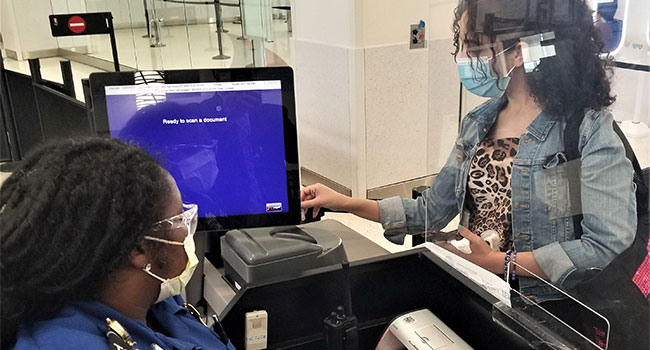
TSA at BWI and Tampa airports gets new Credential Authentication Technology

TSA at BWI and Tampa airports get new Credential Authentication Technology

Transportation Security Administration officers at Baltimore/Washington International-Thurgood Marshall Airport and Tampa International Airport are now using new technology that confirms the validity of a traveler’s identification (ID) and confirms their flight information in near real time.

TSA has 14 Credential Authentication Technology units at BWI and and nine at TPA in use at the airports.

“The Credential Authentication Technology (CAT) units improve upon TSA’s capabilities to detect fraudulent ID such as driver’s licenses and passports at checkpoints and increases efficiency by automatically verifying passenger identification,” said Andrea R. Mishoe, TSA’s Federal Security Director for Maryland. “The CAT system is able to confirm a passenger’s flight status in near real time, adding to the efficiency of the process.”

A CAT unit reads a driver’s license that was inserted into the unit and indicates that this license has expired and is no longer valid for passage through the checkpoint.

When travelers approach the TSA travel document podium, they place their driver’s license or passport into the CAT unit to be scanned. Because the passenger inserts their ID instead of handing it to a TSA officer, it is one less touch-point to help fight the spread of the coronavirus.

In most cases, travelers who approach the TSA travel document checking podium do not have to show their boarding pass because the CAT unit verifies that the traveler is prescreened to travel out of the airport for a flight that day; however, one may be requested for travelers under the age of 18 and/or those with ID issues. Even with TSA’s use of CAT, travelers still need to check-in with their airline in advance and bring their boarding pass to their gate agent to show the airline representative before boarding their flight.

This technology will enhance detection capabilities for identifying fraudulent documents at the security checkpoint.

CAT units authenticate several thousand types of IDs including passports, military common access cards, retired military ID cards, Department of Homeland Security Trusted Traveler ID cards, uniformed services ID cards, permanent resident cards, U.S. visas and driver licenses and photo IDs issued by state motor vehicle departments.

A CAT unit consists of the passport reader, an ID card reader, staff identity verification ID card reader, a monitor, a stand and a UV light.

In addition, it is critical that travelers have their REAL ID-compliant driver’s licenses or other acceptable form of identification by the Oct. 1, 2021, deadline. The CAT units will not accept a driver’s license after Oct. 1, 2021, if it is not REAL ID-compliant.

Passed by Congress in 2005, the REAL ID Act enacted the 9/11 Commission's recommendation that the federal government “set standards for the issuance of sources of identification, such as driver's licenses.” The Act and implementing regulations establishes minimum security standards for state-issued driver's licenses and identification cards and prohibits federal agencies, like TSA, from accepting driver’s licenses and identification cards from states that do not meet these standards for official purposes, such as getting through the airport security checkpoint to board a plane.

Featured

  • A Look at AI

    Large language models (LLMs) have taken the world by storm. Within months of OpenAI launching its AI chatbot, ChatGPT, it amassed more than 100 million users, making it the fastest-growing consumer application in history. Read Now

  • First, Do No Harm: Responsibly Applying Artificial Intelligence

    It was 2022 when early LLMs (Large Language Models) brought the term “AI” into mainstream public consciousness and since then, we’ve seen security corporations and integrators attempt to develop their solutions and sales pitches around the biggest tech boom of the 21st century. However, not all “artificial intelligence” is equally suitable for security applications, and it’s essential for end users to remain vigilant in understanding how their solutions are utilizing AI. Read Now

  • Improve Incident Response With Intelligent Cloud Video Surveillance

    Video surveillance is a vital part of business security, helping institutions protect against everyday threats for increased employee, customer, and student safety. However, many outdated surveillance solutions lack the ability to offer immediate insights into critical incidents. This slows down investigations and limits how effectively teams can respond to situations, creating greater risks for the organization. Read Now

  • Security Today Announces 2025 CyberSecured Award Winners

    Security Today is pleased to announce the 2025 CyberSecured Awards winners. Sixteen companies are being recognized this year for their network products and other cybersecurity initiatives that secure our world today. Read Now

  • Empowering and Securing a Mobile Workforce

    What happens when technology lets you work anywhere – but exposes you to security threats everywhere? This is the reality of modern work. No longer tethered to desks, work happens everywhere – in the office, from home, on the road, and in countless locations in between. Read Now

New Products

  • Luma x20

    Luma x20

    Snap One has announced its popular Luma x20 family of surveillance products now offers even greater security and privacy for home and business owners across the globe by giving them full control over integrators’ system access to view live and recorded video. According to Snap One Product Manager Derek Webb, the new “customer handoff” feature provides enhanced user control after initial installation, allowing the owners to have total privacy while also making it easy to reinstate integrator access when maintenance or assistance is required. This new feature is now available to all Luma x20 users globally. “The Luma x20 family of surveillance solutions provides excellent image and audio capture, and with the new customer handoff feature, it now offers absolute privacy for camera feeds and recordings,” Webb said. “With notifications and integrator access controlled through the powerful OvrC remote system management platform, it’s easy for integrators to give their clients full control of their footage and then to get temporary access from the client for any troubleshooting needs.”

  • Automatic Systems V07

    Automatic Systems V07

    Automatic Systems, an industry-leading manufacturer of pedestrian and vehicle secure entrance control access systems, is pleased to announce the release of its groundbreaking V07 software. The V07 software update is designed specifically to address cybersecurity concerns and will ensure the integrity and confidentiality of Automatic Systems applications. With the new V07 software, updates will be delivered by means of an encrypted file.

  • PE80 Series

    PE80 Series by SARGENT / ED4000/PED5000 Series by Corbin Russwin

    ASSA ABLOY, a global leader in access solutions, has announced the launch of two next generation exit devices from long-standing leaders in the premium exit device market: the PE80 Series by SARGENT and the PED4000/PED5000 Series by Corbin Russwin. These new exit devices boast industry-first features that are specifically designed to provide enhanced safety, security and convenience, setting new standards for exit solutions. The SARGENT PE80 and Corbin Russwin PED4000/PED5000 Series exit devices are engineered to meet the ever-evolving needs of modern buildings. Featuring the high strength, security and durability that ASSA ABLOY is known for, the new exit devices deliver several innovative, industry-first features in addition to elegant design finishes for every opening.