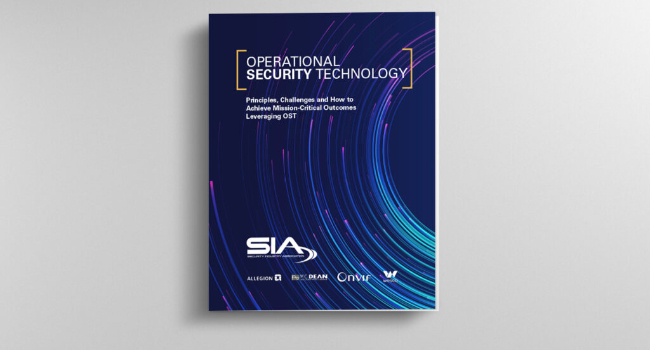
SIA Releases New Report on Operational Security Technology

The Security Industry Association (SIA) has released an impactful new resource – Operational Security Technology: Principles, Challenges and Achieving Mission-Critical Outcomes Leveraging OST. Authored by cyber-physical security experts John Deskurakis and Chris Lynch and developed with support from sponsors Allegion, M.C. Dean, ONVIF and Wesco, this in-depth report explores prominent types of operational security technology (OST) and their corresponding challenges, as well as best practices and strategies for optimal delivery.

This new report serves as beneficial reading for anyone who is installing security systems, as well as end users of security systems, including corporate security practitioners and business managers who are thinking about their security investments and want to gain a greater understanding of OST.

“SIA is proud to present this groundbreaking new report on the critical area of operational security technology,” said SIA CEO Don Erickson. “Having a strong operational tech stack is key to mission success, and this thorough resource offers industry professionals and security technology consumers a deeper understanding of these technologies, which will help them grow their situational awareness, address gaps and prevent common mistakes.”

Key focus areas and elements of the report include:

  • A look at the growing global market demand for operational technology
  • The connection between operational technology, information technology and physical security
  • Definitions and key concepts within OST, including the types of OST that may be connected, integrated and automated within security
  • Common components and key elements of physical access control, video surveillance, detection, perimeter and environmental security and security management systems
  • Key considerations and questions for businesses to consider when rolling out new OST solutions
  • The report also cites a robust array of further recommended reading, including reference material relating to OST and physical security, OST best practices and strategy recommendations for managing OST systems.

Operational Security Technology: Principles, Challenges and Achieving Mission-Critical Outcomes Leveraging OST is available to download for free thanks to the generous support of our sponsors; access the report here.

Featured

  • Brivo, Eagle Eye Networks Merge

    Dean Drako, Chairman of Brivo, the leading global provider of cloud-native access control and smart space technologies, and Founder of Eagle Eye Networks, the global leader in cloud AI video surveillance, today announced the two companies will merge, creating the world’s largest AI cloud-native physical security company. The merged company will operate under the Brivo name and deliver a truly unified cloud-native security platform. Read Now

  • Security Industry Association Announces the 2026 Security Megatrends

    The Security Industry Association (SIA) has identified and forecasted the 2026 Security Megatrends, which form the basis of SIA’s signature annual Security Megatrends report defining the top 10 factors influencing both near- and long-term change in the global security industry. Read Now

  • The Future of Access Control: Cloud-Based Solutions for Safer Workplaces

    Access controls have revolutionized the way we protect our people, assets and operations. Gone are the days of cumbersome keychains and the security liabilities they introduced, but it’s a mistake to think that their evolution has reached its peak. Read Now

  • A Look at AI

    Large language models (LLMs) have taken the world by storm. Within months of OpenAI launching its AI chatbot, ChatGPT, it amassed more than 100 million users, making it the fastest-growing consumer application in history. Read Now

  • First, Do No Harm: Responsibly Applying Artificial Intelligence

    It was 2022 when early LLMs (Large Language Models) brought the term “AI” into mainstream public consciousness and since then, we’ve seen security corporations and integrators attempt to develop their solutions and sales pitches around the biggest tech boom of the 21st century. However, not all “artificial intelligence” is equally suitable for security applications, and it’s essential for end users to remain vigilant in understanding how their solutions are utilizing AI. Read Now

New Products

  • Camden CM-221 Series Switches

    Camden CM-221 Series Switches

    Camden Door Controls is pleased to announce that, in response to soaring customer demand, it has expanded its range of ValueWave™ no-touch switches to include a narrow (slimline) version with manual override. This override button is designed to provide additional assurance that the request to exit switch will open a door, even if the no-touch sensor fails to operate. This new slimline switch also features a heavy gauge stainless steel faceplate, a red/green illuminated light ring, and is IP65 rated, making it ideal for indoor or outdoor use as part of an automatic door or access control system. ValueWave™ no-touch switches are designed for easy installation and trouble-free service in high traffic applications. In addition to this narrow version, the CM-221 & CM-222 Series switches are available in a range of other models with single and double gang heavy-gauge stainless steel faceplates and include illuminated light rings.

  • 4K Video Decoder

    3xLOGIC’s VH-DECODER-4K is perfect for use in organizations of all sizes in diverse vertical sectors such as retail, leisure and hospitality, education and commercial premises.

  • HD2055 Modular Barricade

    Delta Scientific’s electric HD2055 modular shallow foundation barricade is tested to ASTM M50/P1 with negative penetration from the vehicle upon impact. With a shallow foundation of only 24 inches, the HD2055 can be installed without worrying about buried power lines and other below grade obstructions. The modular make-up of the barrier also allows you to cover wider roadways by adding additional modules to the system. The HD2055 boasts an Emergency Fast Operation of 1.5 seconds giving the guard ample time to deploy under a high threat situation.