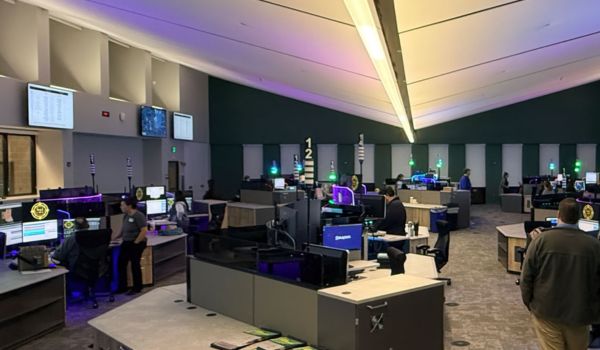
LakeComm emergency communications center

LakeComm 911 Automates Emergency Alarm Processing System

The new technology eliminates manual phone calls from monitoring companies to dispatchers, saving dozens of hours each month.

A regional emergency communications center in Illinois has launched an automated alarm system designed to streamline public safety workflows and accelerate emergency response times.

LakeComm 911, which serves 30 public safety agencies across Lake County, integrated the Automated Secure Alarm Protocol service to transmit alarm notifications directly into its computer-aided dispatch database. The technological upgrade removes the requirement for telecommunicators to manually answer and log thousands of commercial and residential alarm calls annually.

Agency data indicates the dispatch center will process approximately 12,000 automated alarm notifications each year. Traditional handling methods require multiple phone calls between dispatchers and private alarm-monitoring centers to verify incident data. Industry benchmarks show manual data entry can add between two and eight minutes to dispatch timelines while increasing the risk of transcription errors.

The automated protocol functions as an American National Standards Institute accredited standard. The system architecture transmits data from private monitoring networks through the Illinois criminal justice message switch and the National Law Enforcement Telecommunications System. A specialized interface developed by Tyler Technologies allows the incoming data to populate dispatch fields automatically.

Projections show the automation will eliminate up to 133 hours of manual data entry per month for the dispatch center. Administrative officials stated the recovered operational hours will be redirected toward managing high-priority emergency calls and reducing staff workloads.

Twelve national alarm-monitoring companies have established compatibility to transmit automated data to the Illinois center under the new framework.

About the Author

Jesse Jacobs is assistant editor of SecurityToday.com.

Featured

New Products

  • Compact IP Video Intercom

    Viking’s X-205 Series of intercoms provide HD IP video and two-way voice communication - all wrapped up in an attractive compact chassis.

  • Mobile Safe Shield

    Mobile Safe Shield

    SafeWood Designs, Inc., a manufacturer of patented bullet resistant products, is excited to announce the launch of the Mobile Safe Shield. The Mobile Safe Shield is a moveable bullet resistant shield that provides protection in the event of an assailant and supplies cover in the event of an active shooter. With a heavy-duty steel frame, quality castor wheels, and bullet resistant core, the Mobile Safe Shield is a perfect addition to any guard station, security desks, courthouses, police stations, schools, office spaces and more. The Mobile Safe Shield is incredibly customizable. Bullet resistant materials are available in UL 752 Levels 1 through 8 and include glass, white board, tack board, veneer, and plastic laminate. Flexibility in bullet resistant materials allows for the Mobile Safe Shield to blend more with current interior décor for a seamless design aesthetic. Optional custom paint colors are also available for the steel frame.

  • ResponderLink

    ResponderLink

    Shooter Detection Systems (SDS), an Alarm.com company and a global leader in gunshot detection solutions, has introduced ResponderLink, a groundbreaking new 911 notification service for gunshot events. ResponderLink completes the circle from detection to 911 notification to first responder awareness, giving law enforcement enhanced situational intelligence they urgently need to save lives. Integrating SDS’s proven gunshot detection system with Noonlight’s SendPolice platform, ResponderLink is the first solution to automatically deliver real-time gunshot detection data to 911 call centers and first responders. When shots are detected, the 911 dispatching center, also known as the Public Safety Answering Point or PSAP, is contacted based on the gunfire location, enabling faster initiation of life-saving emergency protocols.