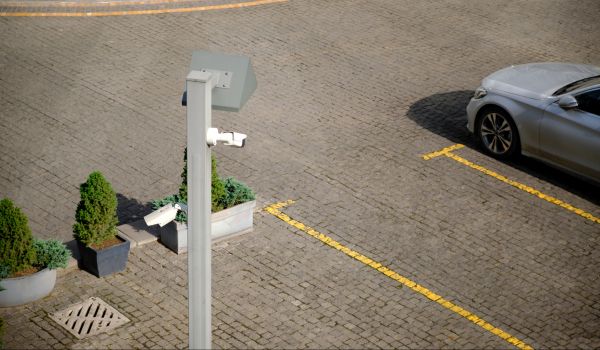
Gunshot Detection: Closing a Critical Gap
Single-sensor acoustic detection paired with on-device AI transforms high-risk parking lots from reactive blind spots into real-time threat verification zones.
- By Timothy English
- Jul 28, 2026
Security planning tends to start at the building perimeter. Doors are hardened, cameras are concentrated at entrances, and response protocols are designed around interior threats. That approach is logical, but it leaves a gap in the places where incidents often begin.
Parking areas consistently rank among the most common locations for violent crime, yet they are still treated as secondary zones. More than seven percent of violent incidents occur in parking facilities, which puts them in a vastly different risk category than most organizations assume.
Where Current Approaches Fall Short
Gunfire incidents in parking environments rarely follow a predictable pattern. They tend to be fast, unplanned and over before anyone fully understands what occurred. In many cases, the weapon is never visible on camera. Witnesses are unreliable or absent. By the time a report is made, the individuals involved are usually long gone.
Traditional tools struggle under those conditions. Cameras can provide coverage, but only within their field of view. PTZ cameras add flexibility and clarity at distance, but they still depend on being pointed in the right direction at the right time. Patrols add presence, but they are intermittent by design.
These approaches are largely observational. They record events, but they do not reliably detect them as they happen.
Detection is the Missing Layer
A gunshot produces a clear, physical signal that something serious has occurred. The issue is that most security systems are not designed to recognize it.
In many environments, the first sign of gunfire still comes from a phone call if it comes at all. That delay creates uncertainty at the exact moment when clarity is needed. Security teams are left trying to decide whether to lock down a building, dispatch responders, or wait for more information. Waiting, however, can have profound consequences, depending on the situation.
Changing the Response Window
Modern acoustic detection systems address that information gap by identifying and finding the source of gunfire instantly. Instead of waiting for multiple devices to confirm an event or sending audio to a remote system for analysis, newer architectures process the signal directly on a single sensor.
That distinction matters operationally because detection, classification and location occur in real time, allowing teams to act while the situation is still unfolding. Just as important is how that detection feeds the rest of the system. Having a single sensor with a 500-foot detection radius cuts the need for fixed multi-sensor mesh networks that need to triangulate a location.
Context Drives Decisions
An alert on its own has limited value. And while putting a dot on a map is important, verification is what gives operators confidence to act. By linking detection directly to video, the system can automatically direct a PTZ camera to the source of the sound. Instead of reviewing footage after the fact, operators can see the scene in real time, alongside the alert.
That combination closes a long-standing gap in outdoor security. It provides both confirmation and context. Operators can assess whether there are victims, whether a suspect is leaving the area, and whether the situation is escalating or contained. This helps operators make decisions based on what is actually happening.
Integration Turns Alerts into Action
Detection also becomes more valuable when it is treated as a trigger rather than a standalone event. In a parking lot scenario, a confirmed gunshot can initiate a coordinated response across systems. Cameras are already positioned. Access points can be secured. Vehicle activity can be captured as it happens. Alerts can be routed to the right personnel with precise location data.
This level of coordination depends first on confidence in the detection. Systems that generate frequent false positives create hesitation and slow response. Systems that can distinguish between gunfire and environmental noise allow teams to act decisively.
Using an advanced AI neural network inside the sensor itself, modern gunshot detection systems can easily tell the difference between fireworks, industrial sounds, car backfires, and actual gunfire. Detection is also stronger when systems can identify both the muzzle blast and the ballistic wave of a bullet in flight.
The Flexibility Factor
Parking environments can create another complication because risk is not static. Traffic patterns change throughout the day, and events can create temporary hotspots. Construction, seasonal activity, or local conditions can shift where incidents are more likely to occur.
Fixed multi-sensor infrastructure does not always keep up with that reality. Detection systems designed around single-sensor architectures and edge processing can be deployed where needed and easily repositioned as conditions and events change.
Parking lots are ideal places to host large temporary events. A mobile trailer with a gunshot sensor and a PTZ camera can be deployed in minutes for events that call for an extra layer of protection. That flexibility allows security teams to treat coverage as an operational decision rather than a permanent constraint.
A Different Way to Think About the Perimeter
Parking areas should be integrated into the security strategy. That requires a different mix of capabilities. Coverage still matters, but detection and response speed carry more weight in environments where incidents unfold quickly and without warning.
Gunshot detection, when implemented with real-time processing and integrated response, provides that missing layer. It gives security teams the ability to detect, verify, and act within the same moment.
Parking lots have long been treated as transitional spaces. From a security standpoint, they behave more like front lines. Organizations that treat parking areas as part of the active security environment will be better positioned to respond quickly and with greater clarity.
This article originally appeared in the July/August 2026 issue of Security Today.