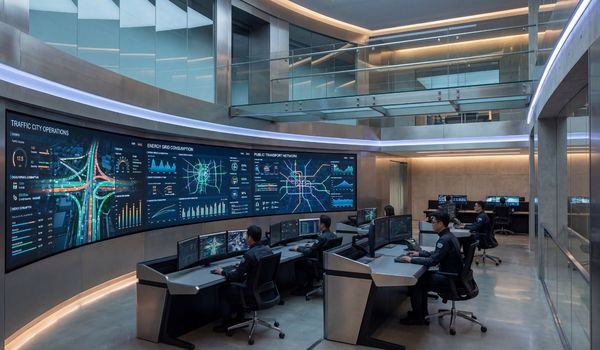
Inside CENTAURE.AI: How Vision AI, Multi-Sensor Fusion and LLM Reasoning Work Together
Modern security operations are shifting from isolated video alerts toward integrated operational intelligence that combines vision data, sensor fusion and LLM reasoning.
- By Dr.Chaouki Kasmi
- Aug 31, 2026
Artificial intelligence is becoming an integral part of modern security operations. Vision AI analyses video, access control systems verify identities and perimeter sensors detect unusual activity. Yet despite these advances, many security environments continue to rely on technologies that operate independently, leaving operators to piece together fragmented information across multiple systems.
As critical infrastructure, transportation hubs and industrial facilities become increasingly connected, the challenge is no longer detecting events. It is understanding how those events relate to one another quickly enough to support effective operational decisions.
This represents the next evolution of security operations.
Rather than relying on individual AI models working independently, organizations are beginning to adopt integrated operational intelligence, bringing together multiple sensing technologies and AI capabilities to create a shared understanding of rapidly evolving situations.
Vision AI remains a critical component of this approach. Its ability to interpret video, recognize objects and identify behavioral anomalies has significantly advanced surveillance capabilities. However, no single technology can provide a complete operational picture. Security incidents rarely unfold within one system. Understanding them increasingly depends on combining information from multiple sources and interpreting how seemingly unrelated events connect.
This is where multi-sensor fusion becomes essential.
By combining information from cameras, access control systems, environmental sensors and other operational technologies into a single operational picture, organizations move beyond isolated events towards contextual understanding. Instead of simply identifying what has happened, operators gain insight into why it matters, what it may affect and how different events relate to one another.
Artificial intelligence then builds on this foundation.
Rather than functioning solely as a detection engine, AI acts as an operational reasoning layer that continuously correlates information, identifies relationships between multiple inputs and highlights emerging risks. Large Language Model (LLM) reasoning further enhances this capability by interpreting those relationships and presenting them in a way that is transparent, contextual and easy for operators to understand.
The objective is not to automate security decisions; it is to improve the quality of human decision-making.
This integrated approach underpins CENTAURE.AI's operational intelligence platform. By combining Vision AI, multi-sensor fusion, advanced AI models and LLM reasoning, the platform transforms fragmented operational information into contextual intelligence. Operators gain a clearer understanding of developing situations, enabling them to prioritise incidents, coordinate responses across multiple teams and maintain human oversight throughout the decision-making process. Importantly, this reflects a much broader evolution in artificial intelligence.
For decades, security systems have largely operated by following predefined rules. If a camera detects motion, generate an alert. If an access badge fails authentication, trigger an alarm. These systems perform valuable tasks, but they understand only the individual event they have been programmed to monitor. The next generation of AI is fundamentally different.
Rather than simply responding to predefined conditions, multiple AI models working alongside multi-sensor fusion create an understanding of the wider operational environment. They continuously interpret relationships between events, recognize developing situations and provide operators with the context needed to determine what requires attention.
This moves security operations beyond isolated alerts towards holistic operational awareness.
Instead of computers simply following instructions, intelligent systems become capable of understanding the broader security picture and communicating that understanding to the people responsible for making operational decisions. Human operators remain firmly in control, but they do so with greater situational awareness, stronger contextual understanding and better decision support than traditional systems could provide.
As security environments continue to grow in complexity, this integrated approach will become increasingly important. The organizations that benefit most from AI will not necessarily be those deploying the greatest number of models or sensors, but those capable of bringing them together into a unified operational intelligence capability.
The future of security operations will not be defined by individual AI technologies working in isolation. It will be defined by intelligent systems that combine multiple AI capabilities and sensing technologies to build a holistic understanding of complex operational environments, empowering humans to make faster, more informed and more confident decisions