Strengthening Your Perimeter Security With Integrated Interoperable IP Sensors

Securing a perimeter has become a complicated affair.

With myriad sensors available to bolster, or even replace, the standard perimeter fence, integrating and monitoring all of this surveillance data can be a formidable task.

Thermal security camera manufacturer FLIR Systems developed an innovative way to bring all of these elements together in a single solution: the Thermal Fence.
Click to enlarge 

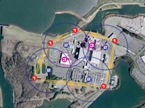
By connecting and interfacing a wide variety of perimeter sensors, Thermal Fence provides an integrated solution for layered, fully-customizable security.

The Thermal Fence is a fully integrated perimeter security solution that provides accurate intrusion detection and instant visual alarm assessment capability while minimizing false alarms.

This solution works over the same IP network as an installation’s existing CCTV and alarm infrastructure, but all of a facility’s sensors, including thermal cameras, radars, RFID, shaker fence sensors, and just about anything else, are integrated into a single convenient display. This gives security professionals instant access to all of the critical information they need in one place.

Because it operates in parallel with the existing security video network, there’s no disruption to that network during the solution’s implementation, and no expense incurred for re-training on a new CCTV sensor networking interface. With its built-in redundancy, even if the existing VMS goes down, the Thermal Fence solution and all of its affiliated sensors will still be on the job.
Click to enlarge 

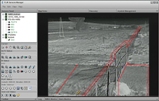
Custom tripwires and exclusion zones allow precise alerting to potential threats.

The core elements of this innovative solution are thermal security cameras. Thermal cameras make pictures from heat not light, so they can see clearly in total darkness and through smoke, dust, and light fog. They allow you to see more and see farther than any other night vision technology on the market today, and even see clearly when looking into direct sunlight.

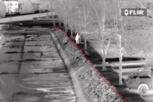
What makes thermal cameras perfect for a thermal fence solution is that their video output is generally much higher contrast than the video provided from standard CCTV cameras, so thermal video works much more reliably with analytics.
Click to enlarge 

High contrast thermal video enables optimal analytics performance.

By combining their thermal security cameras with powerful control and management software, this virtual perimeter provides automated perimeter surveillance, intrusion detection, and alert capabilities with a much lower incidence of false alarms.

All of the thermal cameras and other perimeter security sensors are fully integrated and geo-referenced on a map of the facility for solid situational awareness and threat assessment, so assets can be deployed efficiently, effectively, and to their full advantage.

Because all of the sensors integrated into the system are individually geo-referenced and mapped, its innovative slew-to-cue function commands the system’s pan/tilt thermal security cameras to point at the precise coordinates of any alarm generated by any sensor on the solution’s network. This allows the operator to immediately perform a visual inspection of the alarm, expediting a human response to the event.

With its advanced video analytics, this solution uses algorithms specifically designed to work with thermal video, allowing operators to create customized rules for trip wires, exclusion zones, temperature alarms, and directional alarming while providing a much lower rate of false alarms than other analytics packages.

By making all manner of IP sensors and cameras interconnected and interoperable, meshing thermal video with mapped, geo-referenced sensor positions, the Thermal Fence may well be the model for electronic perimeter design for years to come.

Featured

  • Security Today Announces 2025 CyberSecured Award Winners

    Security Today is pleased to announce the 2025 CyberSecured Awards winners. Sixteen companies are being recognized this year for their network products and other cybersecurity initiatives that secure our world today. Read Now

  • Empowering and Securing a Mobile Workforce

    What happens when technology lets you work anywhere – but exposes you to security threats everywhere? This is the reality of modern work. No longer tethered to desks, work happens everywhere – in the office, from home, on the road, and in countless locations in between. Read Now

  • TSA Introduces New $45 Fee Option for Travelers Without REAL ID Starting February 1

    The Transportation Security Administration (TSA) announced today that it will refer all passengers who do not present an acceptable form of ID and still want to fly an option to pay a $45 fee to use a modernized alternative identity verification system, TSA Confirm.ID, to establish identity at security checkpoints beginning on February 1, 2026. Read Now

  • The Evolution of IP Camera Intelligence

    As the 30th anniversary of the IP camera approaches in 2026, it is worth reflecting on how far we have come. The first network camera, launched in 1996, delivered one frame every 17 seconds—not impressive by today’s standards, but groundbreaking at the time. It did something that no analog system could: transmit video over a standard IP network. Read Now

  • From Surveillance to Intelligence

    Years ago, it would have been significantly more expensive to run an analytic like that — requiring a custom-built solution with burdensome infrastructure demands — but modern edge devices have made it accessible to everyone. It also saves time, which is a critical factor if a missing child is involved. Video compression technology has played a critical role as well. Over the years, significant advancements have been made in video coding standards — including H.263, MPEG formats, and H.264—alongside compression optimization technologies developed by IP video manufacturers to improve efficiency without sacrificing quality. The open-source AV1 codec developed by the Alliance for Open Media—a consortium including Google, Netflix, Microsoft, Amazon and others — is already the preferred decoder for cloud-based applications, and is quickly becoming the standard for video compression of all types. Read Now

New Products

  • Camden CV-7600 High Security Card Readers

    Camden CV-7600 High Security Card Readers

    Camden Door Controls has relaunched its CV-7600 card readers in response to growing market demand for a more secure alternative to standard proximity credentials that can be easily cloned. CV-7600 readers support MIFARE DESFire EV1 & EV2 encryption technology credentials, making them virtually clone-proof and highly secure.

  • 4K Video Decoder

    3xLOGIC’s VH-DECODER-4K is perfect for use in organizations of all sizes in diverse vertical sectors such as retail, leisure and hospitality, education and commercial premises.

  • PE80 Series

    PE80 Series by SARGENT / ED4000/PED5000 Series by Corbin Russwin

    ASSA ABLOY, a global leader in access solutions, has announced the launch of two next generation exit devices from long-standing leaders in the premium exit device market: the PE80 Series by SARGENT and the PED4000/PED5000 Series by Corbin Russwin. These new exit devices boast industry-first features that are specifically designed to provide enhanced safety, security and convenience, setting new standards for exit solutions. The SARGENT PE80 and Corbin Russwin PED4000/PED5000 Series exit devices are engineered to meet the ever-evolving needs of modern buildings. Featuring the high strength, security and durability that ASSA ABLOY is known for, the new exit devices deliver several innovative, industry-first features in addition to elegant design finishes for every opening.