Why Facial Recognition Systems Could Rise In Popularity During Coronavirus Pandemic
Security companies are updating their technology to recognize people wearing masks and measure temperatures, showing how facial recognition could become widely sought as a global security solution.
- By Haley Samsel
- Mar 20, 2020
With fears of spreading the coronavirus at the forefront of everyone’s minds, security companies are arguing that facial recognition systems may be a safer, cleaner option than traditional biometric access control systems.
The claim is not coming without controversy, as fingerprint scanners have become increasingly common as access control solutions at facilities around the world. But as organizations like the Metropolitan Transportation Authority and New York Police Department shut down their typical employee fingerprint scanning protocols due to the pandemic, facial recognition could become a more attractive option to businesses.
Companies that include Dermalog in Germany and Telpo in China are pitching their technology to organizations as a way to avoid spreading the virus and other diseases through contaminated surfaces, the tech site OneZero reported.
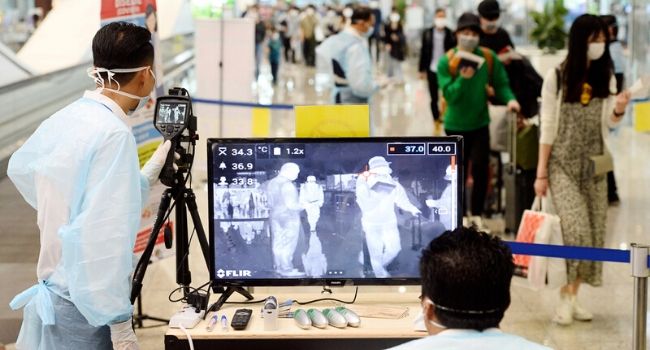
Both companies are adding temperature-sensing technology to their facial recognition programs to meet demand for ways to detect if someone has a fever and should be asked to leave a facility or seek medical attention. Dermalog’s temperature sensing system is already being used by Thailand’s government for border control purposes, according to OneZero.
Telpo plans to launch facial recognition terminals with temperature sensing software that will work even if a person is wearing a mask, the company said.
“This technology can not only reduce the risk of cross-infection but also improve traffic efficiency by more than 10 times, which will save time and reduce congestion,” Telpo wrote in a press release. “It is suitable for government, customs, airports, railway stations, enterprises, schools, communities, and other crowded public places.”
The new developments in facial recognition systems’ ability to recognize mask-wearers came as the coronavirus spread through China. Chinese company Hanwang told The Financial Times that they updated their software to recognize nurses wearing masks after receiving several requests from hospitals in January.
Now Hanwang’s devices, which the company said rose in accuracy from about 50 percent to 95 percent, can work with a database of up to 50,000 employee faces. Chief technical officer Huang Lei told the Times that the system can use photos from the Chinese police identification card database but is not designed for incredibly large databases used by law enforcement.
According to OneZero, China’s Hanvon and Spain’s Herta say their facial recognition systems now work with and without masks, showing a growing demand for the technology. But doubts about the technology’s accuracy remains. A December report by the federal government's National Institute of Standards and Technology found that a majority of commercial facial recognition systems in the U.S. are less accurate at identifying people of color as compared to white people.
As the coronavirus pandemic continues to reshape people’s lives around the world, it would not be surprising if facial recognition steps in to become a widely sought solution for security needs. Kai-Shing Tao, chairman and CEO of Remark Holdings, which manufactures KanKan AI products, echoed this point in early March, according to BiometricUpdate.com.
“Though many countries have advocated the use of masks to try to prevent the spread of infectious diseases, the ability of governmental authorities in some countries to monitor the use of preventative measures such as masks has been limited by lack of efficient technology and reliance on manual methods,” Tao said. “We now see an opportunity to expand our health and safety capabilities to retail stores and areas with high traffic.”
Photo by NAUFAL ZAQUAN / Shutterstock.com