Mega-Event Security Requires a Comprehensive Security Program
Modern stadium security operates like a temporary city command center, merging regional transit data and AI video analytics to ensure frictionless fan experiences.
- By Dean Cunningham
- Jul 28, 2026
When people think about stadium security, they picture waiting at the entrances to walk through metal detectors. Security guards poking around in their bags. Security cameras mounted everywhere. Officers patrolling the concourse. And, if they are lucky enough to be heading to a luxury suite, presenting a badge or code to access a more restricted level.
Those are all part of a comprehensive security program, but for the most high-profile events, those measures are just the tip of a much larger operation. On such occasions, stadiums function much like temporary cities and securing them requires thinking far more expansively.
This includes security measures beyond the venue itself and that extend beyond the event’s timeline. Security plans must cover the period from when people start heading to the stadium and end only after everyone has safely and efficiently departed.
During those many hours, security teams must analyze and prioritize information from countless systems and devices, anticipate and mitigate security risks, respond to and manage emergencies, and collaborate with multiple jurisdictions – all with the aim of delivering a safe, low-stress fan experience.
Fortunately, today’s technology, which leverages video and data in new ways, is allowing security operations to do just that – acting on facts rather than assumptions, streamlining response efforts, and keeping security efforts visible but not unreasonably intrusive. Here is how those teams’ run events with more confidence, better results and happier fans.
The Expanding Perimeter
Physical security plans are designed in layers, starting with the perimeter and moving inward. But when dealing with large-scale events, the perimeter is not a fixed line; it is a ripple that moves inward and outward over time.
It starts with staff and vendors arriving. It expands as gates open and crowds gather. Then, it pushes outward into surrounding streets and transit hubs. In some cases, the effective perimeter can stretch for miles.
If historical data shows congestion begins two miles from the stadium, that is where planning needs to start. Steps may include adjusting traffic signals, deploying staff to key intersections, or rerouting vehicles before they reach the venue.
Public transit may add more trains or buses to accommodate anticipated ridership. Certain stations may only be accessible to event ticket holders. The city may close streets directly adjacent to the stadium to all but foot traffic.
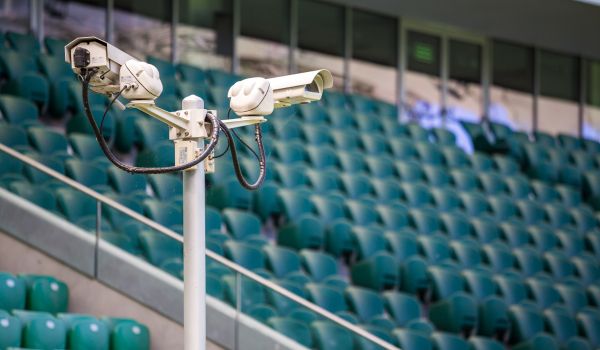
This entire ecosystem should be visible via stadium or municipal cameras. Temporary, rapid-deploy surveillance solutions, including drones, can extend visual coverage to areas not covered by existing camera networks. The cameras are no longer just for surveillance. Video analytics and occupancy tracking at parking areas can redirect vehicles before backups form.
Similar analytics can watch pedestrian movement, issuing alerts when crowds are forming, count foot traffic and estimate the number of people in a particular area. LPR and facial recognition can monitor VIPs and celebrities arriving at the event and ensure they receive proper security coverage.
These same technologies can also notify users of known bad actors and assist in their removal. All this data may be fed to GIS platforms to create layered visualizations that support coordinated decision-making in real time.
Taking steps like these ensures fans arrive in a positive state of mind, ready to enjoy themselves. Plus, smooth arrivals can reduce early departures. Eighty percent of Americans report leaving a major event before the end to avoid parking lot and roadway congestion – causing them to miss a winning field goal or a favorite song.
This can be a disappointing finish to a memorable day. It is a reminder that how people arrive and leave is not just a logistical issue – it is a critical part of the overall experience.
Managing the Moment
Once an event is underway, the challenge becomes prioritization. With so much information available from cameras, access control systems, sensors, and other monitoring technologies, how do teams determine what matters most and what can wait?
When a stadium’s security landscape resembles that of a temporary city, it must have a Security Operations Center (SOC) much like a city’s centralized command center. With the help of powerful AI tools, today’s SOCs can integrate and analyze data from disparate systems in real time, identify anomalous conditions, rank their threat levels, and issue alerts and notifications accordingly. Instead of monitoring isolated systems, operators can see how everything connects and make decisions based on the full picture.
Just as important as having that visibility is knowing how to interpret it. Every event has a baseline – what normal traffic looks like, how crowds typically move, and where lines tend to form. Experienced operators understand those patterns, and today’s systems help reinforce their interpretations with real data.
When something deviates from what is expected, it is often an early indicator of what could become a bigger problem. In many cases, these anomalous conditions are not security threats – at least initially – but operational issues. The ability to catch and correct them quickly keeps the event running smoothly.
The centralization of data also facilitates cross-agency coordination. In many cases, representatives from different agencies are working out of the same SOC or are connected through shared platforms that provide a common operating picture. Mirroring how cities manage emergency management, stadium security brings together private security, law enforcement, fire, EMS, and transit authorities with a unified view of what is happening and who is responsible for what.
Effective collaboration requires extensive planning well in advance of the event – defining roles, establishing communication protocols, and making sure the chain of command is clear. By laying this groundwork, teams can launch a coordinated response to any security incident, informed by the same real-time data rather than working in silos.
The Experience is the Outcome
Ultimately, the goal of event security is more than keeping everyone safe; it is making sure people enjoy themselves. Difficulty getting to the venue, long and confusing lines, and security measures that are either too restrictive or seemingly lax all negatively impact the fan experience.
The best security strategies do not just mitigate threats – they reduce friction by removing bottlenecks and keeping lines moving. But convenience cannot come at the expense of public safety. There is a balance to strike.
Security must be visible enough to make people feel safe without becoming a distraction. Fans expect cameras and a security presence, but at some point, their perception can shift from reassurance to discomfort. Ideally, technology and security personnel should blend into the environment.
Pre-event communications and transparency by event management can help reduce potential fan discomfort. If new technologies are being used, such as drones, bodycams or facial recognition, the public should know about them in advance. When people understand what is in place and why, as well as how technology is notbeing used, they are far more likely to accept it.
For example, transparency can make the difference between fans perceiving a hovering drone as reassuring instead of menacing. Or feeling appreciative, instead of anxious, about facial recognition systems because they understand the cameras only identify people who are known security threats.
When security is done right, fans are not thinking about it. They are focused on the game or the concert they came to see.
And when they reflect on it, they will remember what an exciting time they had – not just because they felt safe, but because everything worked the way it was supposed to. Making this happen at the largest high-visibility events means that the behind-the-scenes effort must be as impressive as the event itself.
This article originally appeared in the July/August 2026 issue of Security Today.